

Introduction
No material has ever matched natural stone in a bathroom. Long before porcelain learned to imitate it, stone was the luxury bathroom — the travertine of Roman baths, the Carrara marble of grand hotels, the glowing onyx of palace hammams. In 2026, stone is having its biggest moment in decades, and the look has matured: less glossy showroom, more quiet geology.
The best natural stone bathroom ideas all share one shift: toward honed, touchable finishes — stone that looks like it was cut from a mountainside rather than polished in a factory. Travertine with its soft pitting, marble with calm veining, onyx that glows when backlit: each stone has a personality, and choosing the right one (and finishing it the right way) is what separates a bathroom that feels timeless from one that feels like a tile showroom.
Below is a quick stone primer, then twelve natural stone bathroom ideas using travertine, marble, and onyx — from a single backlit panel to a full floor-to-ceiling stone envelope.
Natural Stone Bathroom 101: What to Know Before You Choose
Four things to understand before you fall in love with a slab:
- Honed vs. polished: Honed stone is matte, soft, and forgiving — it hides etching, water spots, and wear, and it reads as calm and contemporary. Polished stone is glossy and dramatic but shows every etch mark and footprint. For bathrooms in 2026, honed wins almost every time.
- Porosity and sealing: Travertine and marble are porous. They must be sealed at installation (a quality penetrating sealer, $0.50–$1 per sq ft of product) and resealed every 2–4 years depending on use. Sealing doesn’t make stone stain-proof — it buys you time to wipe up.
- Bookmatching: When a slab is cut, the two resulting faces mirror each other. Placing them side by side creates a symmetrical, butterfly-like veining pattern — the single most dramatic move in stone design. Always ask your fabricator about bookmatch options before slabs are cut.
- The stones themselves: Travertine is warm, pitted, and full of movement — the cozy one. Marble (Carrara, Calacatta, Statuario) is cooler, veined, and classic — the elegant one. Onyx is translucent and theatrical — the showstopper, best used in moments, not entire rooms.
Keep these in mind as you read the twelve ideas — each one leans on at least one of these principles.
1. The Full Travertine Envelope
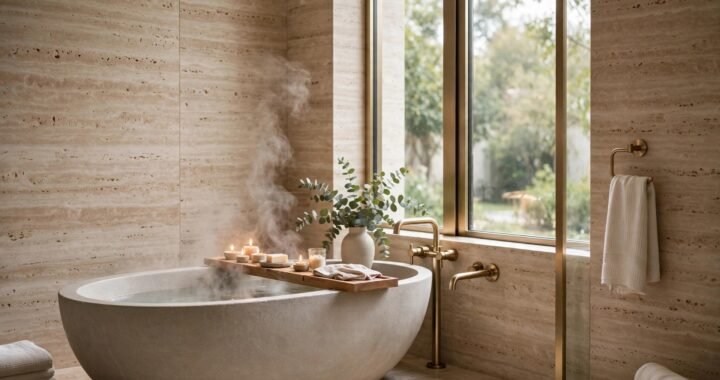
The most enveloping move in stone bathroom design: run the same travertine from floor to walls to shower with no visual breaks. Walking into a bathroom wrapped in warm, pitted travertine feels like stepping into a thermal grotto — the stone’s natural variation becomes the entire decoration, and you need almost nothing else in the room.
Use large-format tiles or slabs (60×120 cm minimum) to minimize grout lines, and choose a filled-and-honed travertine so the surface is smooth to the touch while keeping its character. Carry it across the shower threshold with a curbless design so the floor reads as one continuous plane.
How to do it: Budget $15–$30 per sq ft installed for quality travertine tile work, more for slab. Seal thoroughly — travertine’s pits are beautiful but they hold onto soap scum if unsealed. A single stone + brushed brass fixtures + oak accents is a complete palette; resist the urge to add a second “feature” material.
2. A Bookmatched Marble Feature Wall
If you choose just one of these natural stone bathroom ideas, make it this. Two bookmatched marble slabs behind the vanity or tub create a symmetrical veining composition that looks like abstract art — no two bathrooms on earth will have the same one. Calacatta with bold veining makes the biggest statement; softer Carrara or Arabescato suits calmer schemes.
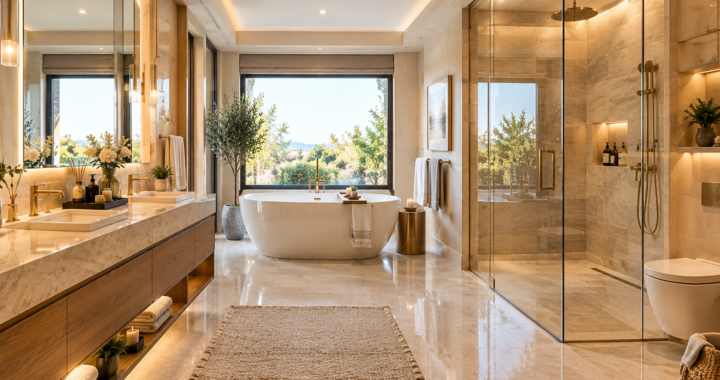
The wall should be the room’s focal point — behind a floating vanity with a backlit mirror, or behind a freestanding tub. Keep everything else quiet: plain floor, simple fixtures, minimal hardware. The stone is the art; the room is the frame.
Worth knowing: Bookmatched slabs need to be selected as a pair at the stone yard — you can’t bookmatch after cutting. Budget $80–$200+ per sq ft installed for bookmatched marble feature walls including fabrication. Photograph and number the slabs at the yard so the installer places them in the right orientation.
3. Backlit Onyx: Stone That Glows
Onyx is translucent — light passes through it. Mounted as panels with LED backlighting, it glows like amber, honey, or sunset depending on the variety. A backlit onyx wall behind a vanity, a glowing onyx shower niche, or onyx panels flanking a tub turn the bathroom into something genuinely otherworldly after dark.
Onyx is softer and more delicate than marble, so use it in moments, not entire rooms — feature panels, a vanity front, a tub surround. Pair it with dimmable 2700–3000K backlighting; the warm light is what makes the stone come alive.
Designer tip: Green onyx and honey onyx photograph beautifully but look at full slabs in person — translucency varies enormously between bundles. Budget $100–$250 per sq ft installed for backlit onyx panel systems including the lighting. And put the LEDs on a separate dimmer: full brightness for drama, low glow for night-time calm.
4. Honed Carrara Marble, Done Right
Carrara is the people’s marble — softer grey veining, lower price than Calacatta, and endlessly versatile. The 2026 way to use it is honed, large-format, and quiet: 60×120 cm honed tiles on walls and floor, minimal contrast grout, brushed nickel or chrome fixtures. It reads as effortlessly luxurious rather than trying-too-hard.
Carrara etches — lemon, vinegar, and harsh cleaners will leave dull marks. In a bathroom this matters less than in a kitchen (fewer acids), but choose bath products wisely and wipe down the vanity top. Honed finishes hide etching far better than polished, which is exactly why honed is the right call.
How to do it: Honed Carrara tile runs $12–$25 per sq ft installed — the most accessible real marble. Use it in a secondary bathroom or powder room first if you’re nervous; a small Carrara powder room is a classic designer move that never fails.
5. A Carved Stone Vanity Top with Integrated Basin
The ultimate stone flex: a vanity top carved from a single block with the basin sculpted into the stone itself — no separate sink, no seams, just one continuous carved surface. Travertine and marble both carve beautifully. It reads as ancient and modern simultaneously, like something excavated and repurposed.
This is a fabricator’s piece — find a stone workshop, not a kitchen showroom. The top needs to be at least 5–8 cm thick to carve a proper basin depth, and the waste and tap holes are core-drilled. Wall-mounted taps pair perfectly, keeping the carved surface completely clear.
Worth knowing: Budget $2,000–$6,000 for a carved stone vanity top depending on stone and size — comparable to a high-end designer vanity, but utterly unique. Seal the basin area meticulously; it’s the wettest square foot in the room.
6. Tadelakt: The Seamless Stone Plaster
Tadelakt is a Moroccan lime plaster, polished with stone and sealed with olive-oil soap until it’s waterproof — a seamless, hand-troweled surface that looks like honed stone but has zero grout lines. In warm whites, clays, and greiges, it’s the softest possible wall finish for a bathroom, and it’s been waterproofing hammams for centuries.
Because it’s applied by hand, every tadelakt wall is subtly unique — gentle undulations catch light the way no tile can. It suits curved walls, niches, and shower enclosures beautifully. Hire a true tadelakt artisan; this is not a DIY plaster job.
Designer tip: Tadelakt needs re-soaping (its traditional maintenance) every year or two in wet zones — a 30-minute job with olive-oil soap. Budget $25–$50 per sq ft installed. Pair it with travertine floors and the room feels carved from a single warm rock.
7. The Curbless Stone Shower with Linear Drain
Stone shows best when nothing interrupts it. A curbless (walk-in) shower with the same stone running from bathroom floor straight into the shower — drained by a single linear drain at one edge — is the cleanest expression of the material. No curb, no threshold, no visual stop: just stone, water, glass.
The floor needs a single-plane slope (2% grade) toward the linear drain, which is simpler to tile in large format than a center drain’s four-way slope. Use a tile-in linear drain cover so the drain itself disappears into the stone pattern.
How to do it: The waterproofing and sloping are the skilled part — budget an extra $1,500–$3,000 over a standard shower for proper curbless construction with linear drain. Frameless glass (10–12 mm) completes the invisible look. This is the shower that makes guests ask who your architect was.
8. Onyx and Marble Vessel Basins
A vessel basin carved from a single piece of onyx or marble is functional sculpture. Onyx glows faintly even in daylight; marble vessels show their veining in three dimensions as light wraps around them. On a floating travertine or oak vanity, one carved vessel beats any manufactured sink.
Size them honestly: 40–45 cm diameter is comfortable for daily use; smaller looks jewel-like but splashes. The stone must be sealed inside and out, and the waste fitting should be a matching finish — brushed brass with honey onyx, matte black with dark marble.
Worth knowing: Carved stone vessels run $600–$2,500 each. Because each is cut from different stone, buy the pair (for a double vanity) from the same block so the veining relates. And check the weight — a solid marble vessel can exceed 20 kg; your vanity must be built to carry it.
9. Travertine Mosaic Shower Floors
Small-format stone where it matters most: underfoot. A travertine or marble mosaic on the shower floor gives natural grip (more grout lines = more traction), massages bare feet pleasantly, and adds intricate detail that contrasts beautifully with large-format wall stone. Tumbled travertine mosaics in 5×5 cm or pebble cuts are the classics.
The grout is the maintenance item here — use an epoxy grout ($$$ but worth it) or a high-quality cementitious grout with sealer, in a tone close to the stone so it reads as texture rather than grid. Small mosaics also conform to the shower slope far more easily than large tiles.
Designer tip: Run the mosaic up the shower curb face or as a border strip to tie it to the room. Budget $15–$35 per sq ft installed for stone mosaic floors. It’s a small area — splurge on the prettiest mosaic in the showroom.
10. The Stone-Clad Tub Surround
A freestanding tub gets the glory, but a stone-clad built-in tub delivers the grotto feeling. Clad the tub apron and deck in the same travertine or marble as the walls, mitre the edges for a crisp stone-to-stone corner, and the tub reads as carved from the room itself. Add a wide stone deck (25–30 cm) on one side for bath rituals — candles, books, a carafe of water.
This works brilliantly in bathrooms where plumbing or budget rules out a true freestanding sculptural tub. The cladding gives you 80% of the monolithic stone look at a fraction of the cost, and the deck is genuinely useful in a way freestanding tubs aren’t.
How to do it: Budget $2,000–$5,000 for stone tub cladding depending on stone choice. Leave a discreet removable access panel for the plumbing — future you will be grateful. Undermount the tub rim slightly below the stone deck edge for the cleanest line.
11. Mixing Stones: The Two-Stone Rule
The question every stone lover asks: can I mix marble and travertine? Yes — with discipline. The designer rule is two stones maximum, and they must differ clearly in either tone or scale: warm travertine floors with cool Carrara walls works because the contrast is legible; two similar beige marbles just look like a mistake.
The safest formula: one stone for floors + shower (the workhorse, usually travertine or a quiet marble), one stone for the feature moment (bookmatched wall, vanity top, or onyx accent). Everything else — wood, brass, linen — plays supporting roles. Three stones is a crowd; the eye stops knowing where to rest.
Worth knowing: When in doubt, pull physical samples into the actual bathroom and look at them in morning and evening light. Stone changes dramatically under different color temperatures — a marble that looks crisp white at noon can read grey-beige under 2700K evening light. Never choose stone from a showroom sample alone.
12. Stone Beyond the Bathroom: The Threshold Detail
The final luxury is continuity — letting the bathroom stone escape the bathroom. A travertine threshold that flows into the bedroom, the vanity stone wrapping onto a dressing-table top, or the shower marble continuing as the ensuite’s fireplace surround: these threshold moments make the stone feel architectural rather than decorative.
Even one move counts. The most effective is also the simplest: run the bathroom floor stone 60–90 cm into the adjoining bedroom or dressing area as a “stone rug” inlay bordered by timber flooring. It signals that the ensuite and bedroom are one composed suite, not two rooms that happen to share a wall.
Designer tip: This is where the master suite thinking pays off — plan stone, timber, and brass as one palette across bedroom, dressing, and bath. The most luxurious homes don’t decorate rooms; they compose sequences.
Natural Stone Bathroom Mistakes to Avoid
1. Polished stone everywhere. The number-one stone regret. Polished marble floors show every water spot, etch, and footprint within weeks, and the whole room reads as a 2005 hotel lobby. Honed is calmer, more forgiving, and unmistakably current — reserve polish for small accents if you love the gleam.
2. Skipping the sealer (or sealing once and forgetting). Unsealed travertine absorbs everything — soap, oils, tinted bath products — and stains become permanent residents. Seal at install, reseal every 2–4 years, and wipe up spills promptly. Sealer is cheap; regret is expensive.
3. Choosing stone from a tiny sample. A 10×10 cm chip tells you nothing about how a slab’s veining behaves at full scale. Always view full slabs at the stone yard for feature walls, and lay out large tile samples on the floor of the actual room. The most expensive stone mistake is the one you only see at full size.
4. Ignoring slip resistance. Polished marble on a bathroom floor is genuinely dangerous when wet. Check the slip rating (you want R10 or higher, or a DCOF above 0.42 for wet areas) and favor honed, tumbled, or textured finishes underfoot. Beauty that sends you to the emergency room isn’t luxury.
5. No expansion respect. Stone moves microscopically with temperature and moisture; installers who butt large-format stone tight with hard grout invite cracks. Proper expansion joints (often hidden at perimeters under skirting) and flexible adhesives are invisible when done right and catastrophic when skipped. Hire tilers who do stone weekly, not occasionally.
Frequently Asked Questions
Is marble too high-maintenance for a bathroom?
Less than its reputation suggests. Bathrooms see fewer acids than kitchens, so etching is manageable — especially with honed finishes, which camouflage marks. The real routine is simple: squeegee or wipe down after use, pH-neutral cleaner only, reseal every few years. If you can live with stone developing a soft patina over time, marble is perfectly livable.
Travertine or marble — which should I choose?
Choose by feeling, not prestige. Travertine is warmer, more textured, and more forgiving — it suits relaxed, spa-like, earthy schemes. Marble is cooler, more formal, and more dramatic — it suits classic and contemporary luxury. Both need sealing; travertine’s pits need slightly more attention. Many designers use travertine for floors and marble for feature walls to get both.
What is the cheapest way to get the natural stone look?
Honed travertine-look porcelain in large format: $5–$10 per sq ft installed, zero sealing, excellent slip ratings. It’s not stone — connoisseurs can tell — but for rental bathrooms or tight budgets it delivers 80% of the calm. If budget allows one real-stone moment, make it the vanity top or a feature wall where you’ll touch and see it daily.
How do I clean natural stone without damaging it?
Only pH-neutral stone cleaners — never vinegar, bleach, or abrasive powders, which etch and dull the surface. A microfiber cloth and neutral cleaner handle daily duty; a soft squeegee after showers prevents water spots. For travertine’s pits, a soft brush keeps soap residue from settling in.
Can I use onyx in a shower?
Not recommended as the main shower surface — onyx is soft, porous, and vulnerable to both water chemistry and cleaning products. Use it where it shines: backlit feature panels, vanity fronts, niches, and tub surrounds outside the direct spray zone. Let marble or travertine do the wet work.
Does natural stone add resale value?
Quality stone bathrooms consistently rank among the highest-ROI renovation elements — real estate professionals regularly cite stone-clad primary bathrooms as strong value drivers. The key is timeless choices: honed finishes, calm veining, and neutral palettes outlast every trend cycle, while yesterday’s dramatic polished excess dates fast.
Final Thought
These natural stone bathroom ideas ask something of you — sealing, gentle cleaners, acceptance of patina — and give back more than they ask. A bathroom in travertine, marble, or onyx doesn’t just look expensive; it feels geological, connected to something older and slower than trends. Choose honed over polished, seal what you install, mix no more than two stones, and let the material do what it has done for millennia: make a room feel permanent.
Explore more: Luxury Modern Washroom Ideas · Spa-Inspired Luxury Washrooms: 12 Wellness Features · Master Suite Layouts: Glass Partitions & Privacy Zones
[…] Explore more: Luxury Kitchen Ideas · Natural Stone Bathroom Ideas […]