

Introduction
The most luxurious room in a 2026 home isn’t the kitchen or the living room — it’s the washroom. After years of treating bathrooms as purely functional spaces, designers and homeowners alike have rediscovered what high-end hotels and destination spas always knew: the smartest spa bathroom ideas turn a bathroom into a daily wellness ritual, not just a pit stop.
The spa-inspired washroom isn’t about gimmicks. It’s about engaging all five senses with intention — enveloping heat, the sound and feel of water, light that flatters and calms, materials that feel honest under bare feet, and air that smells faintly of eucalyptus rather than cleaning products. Done well, even a modest bathroom can deliver the exhale you feel walking into a great spa.
Below are the four pillars every spa washroom rests on, then twelve wellness features you can mix and match — from weekend-level upgrades to full renovation showstoppers.
The Four Pillars of Great Spa Bathroom Ideas: Start Here
Before the features, understand the framework. Every great spa — from a ryokan in Kyoto to a hammam in Istanbul — is built on the same four pillars. Get these right and the fixtures almost choose themselves:
- Heat: Warmth is the spa’s first language. Heated floors, steam, hot stone, warm towels — heat relaxes muscles, opens pores, and signals the nervous system to stand down. A spa washroom should never greet you with a cold tile shock.
- Water: Not just plumbing — water as experience. Generous flow, rain from above, the visual calm of a still bath surface. Multiple water moments (shower + tub, or shower + steam) let the room serve different moods.
- Light: Spas never blast you with a single overhead downlight. Layered, dimmable, warm light — ideally with a chromotherapy option — lets the same room feel energizing at 7 a.m. and meditative at 10 p.m.
- Calm: The absence of visual noise. Concealed storage, quiet materials, no clutter on the vanity, and sound that’s either soft music or genuine quiet. Calm is designed, not accidental.
Keep these four in mind as you read the twelve features — each one serves at least one pillar, and the best serve three.
1. A Proper Steam Shower (Not Just a Hot Shower)
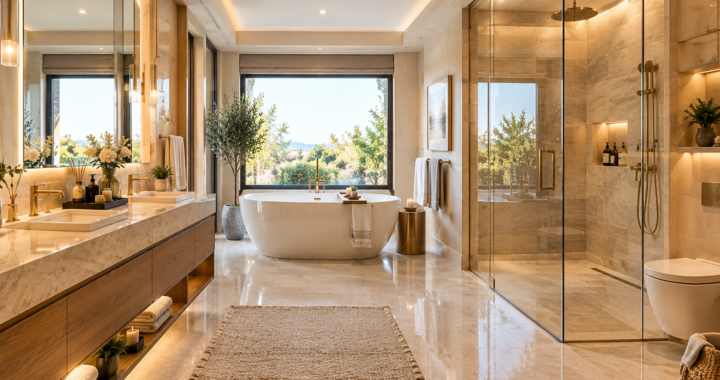
The single most transformative spa feature you can add. A steam shower is an enclosed, sealed shower space with a dedicated steam generator that fills the cabin with 40–45°C humid warmth — the same enveloping heat as a spa steam room. Fifteen minutes in one after a long day genuinely changes how you feel: muscles release, sinuses clear, skin glows.
The enclosure must be sealed — floor-to-ceiling glass or solid walls, a tight door, and a sloped or curved ceiling so condensation runs to the walls instead of dripping on your head. The generator (sized by cubic footage of the enclosure, typically 5–10 kW for residential) lives in a nearby vanity, closet, or ceiling void.
How to do it: Budget $3,000–$8,000 for the generator plus enclosure upgrades on top of normal shower costs. Add an aromatherapy oil well to the steam head — a few drops of eucalyptus oil turns steam into a full respiratory ritual. And install a transom vent or operable panel: you’ll want to purge the steam quickly after your session.
2. Radiant Heated Floors
Nothing kills the spa illusion faster than cold tile underfoot on a winter morning. Electric radiant floor mats (or hydronic tubing for larger renovations) warm the floor to a gentle 28–32°C, and the whole room feels 3–4 degrees warmer without touching the thermostat. Stone and porcelain — the classic spa materials — are thermally ideal because they conduct and hold heat beautifully.
Worth knowing: Electric mat systems cost roughly $10–$20 per square foot installed and can retrofit under tile in a standard renovation. Always pair with a programmable thermostat with floor sensor — set it to pre-warm the bathroom 30 minutes before your alarm. Stepping onto warm stone at 6:30 a.m. is a small daily luxury that never gets old.
3. A Freestanding Sculptural Tub
The visual anchor of these spa bathroom ideas. A freestanding tub — oval, organic, in matte solid-surface or stone composite — reads as sculpture, not plumbing. Unlike a built-in alcove tub, it can sit where the light is best: before a window, under a skylight, or as the centerpiece of a wet zone. The ritual of drawing a bath becomes the point, not an afterthought.
Size honestly: a proper soaking tub needs 150–170 cm of length for most adults to stretch out. Allow at least 75–90 cm of clear floor around three sides for cleaning access and visual breathing room — a tub crammed against walls loses all its sculptural power.
Designer tip: A floor-mounted tub filler in brushed brass or matte black, placed at the tub’s shoulder end, is the jewelry that completes the look. Budget $800–$2,500 for a quality freestanding filler — and confirm your floor structure can carry 300+ kg of tub plus water plus bather before you fall in love with a stone model.
4. Natural Stone, Honed Not Polished
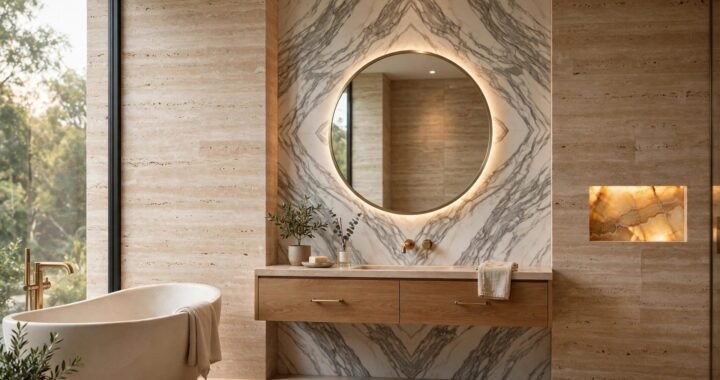
Spa calm lives in materials that feel ancient and honest. Travertine, honed Carrara marble, tadelakt plaster, or large-format stone-look porcelain in warm greige — these are the surfaces of great spas. The critical word is honed: matte, soft, touchable. Polished glossy stone reads as hotel-lobby circa 2005; honed stone reads as a thermal bath in the Alps.
How to do it: Run the same stone from floor to walls (and ideally the shower) for the seamless, enveloping effect spas are famous for. Large-format tiles (60×120 cm or bigger) minimize grout lines, which minimizes visual noise. Seal natural stone properly at install and reseal every few years — honed finishes are more forgiving of etching than polished ones, but they’re still stone.
5. Chromotherapy Lighting
Colored light therapy sounds like a gimmick until you try it. Modern LED systems let your shower or tub area cycle through — or hold — colors: blue for calm, green for balance, warm amber for relaxation, and a brighter white-blue for an energizing morning. The science on mood effects is soft, but the experience of bathing in slowly shifting warm light is undeniably transporting.
Worth knowing: You don’t need a dedicated chromotherapy fixture. Waterproof RGBW LED strips ($30–$80 per strip) tucked into a shower niche, behind a floating vanity, or along a cove ceiling, driven by a simple controller or smart-home scene, deliver 90% of the effect. Keep the default scene warm amber at 2700K — reserve the colors for deliberate ritual moments.
6. A True Rain Shower with Body Jets
Spa showers are about abundance. A 25–30 cm ceiling-mounted rain head delivers that drenching, standing-in-warm-rain sensation a standard wall arm never can — but the real spa move is pairing it with a handheld wand on a slider bar (for rinsing and cleaning) and, if your water pressure allows, two or three body jets at torso height. Switching between them mid-shower is the hydrotherapy contrast spas charge money for.
Pressure is everything: rain heads need 2.5–3 bar minimum to feel luxurious rather than drizzly. In low-pressure homes, a pressure-boosting pump ($200–$500) transforms the experience more than any fixture upgrade.
Designer tip: Put the shower controls at the entrance of the shower, not under the water stream — so you can warm up the water before stepping in. And add a small recessed niche at chest height for products; bending to floor level for shampoo breaks the spell.
7. Heated Towel Rails (Proper Ones)
A warm towel after a bath is one of life’s great small pleasures, and a proper hydronic or electric heated towel rail delivers it daily. Beyond comfort, it dries towels fast — critical in a steamy spa washroom where damp towels turn musty. Choose a rail sized to your towel load: 60 cm wide for a couple, wider for family bathrooms.
How to do it: Electric models ($150–$600) wire into the bathroom circuit and work with a timer — set it to warm up before bath time. Position the rail within arm’s reach of the tub or shower exit. Ladder-style rails in brushed brass or matte black double as a design feature; the old chrome zigzag reads dated.
8. Sound: Built-In, Invisible Audio
Spas understand that silence — or soft sound — is part of the treatment. In-ceiling or in-wall bathroom-rated speakers, connected to your phone or smart home, let you play ambient playlists, rain sounds, or a podcast without a portable speaker cluttering the vanity. Two small speakers beat one: stereo at low volume fills the room without any single hot spot.
Worth knowing: Moisture-rated in-ceiling speakers cost $100–$300 per pair plus wiring. If you’re renovating anyway, the incremental cost is tiny. Add a simple wall keypad or voice control — fumbling with a wet phone to change tracks is the opposite of calm.
9. Aromatherapy, Built Into the Room
Scent is the fastest route to the spa feeling, and the pros don’t rely on a candle alone. Layer it: an ultrasonic diffuser with eucalyptus or bergamot oil on the vanity, a bundle of fresh eucalyptus hung from the shower head (the steam releases its oils — replace every 2–3 weeks), and the steam-shower oil well from idea #1 if you have one. Three gentle sources beat one overpowering one.
Designer tip: Keep scents in the green-herbal-citrus family (eucalyptus, rosemary, bergamot, cedar). Heavy florals and sweet gourmand fragrances read as perfume counter, not spa. And never mix more than two scents at once.
10. A Floating Vanity with a Backlit Mirror
Visual lightness is calming. A wall-hung vanity — floating 25–30 cm off the floor — makes the floor read as one continuous stone plane and the room feel larger. Pair it with a round or arched mirror ringed in warm backlight (2700–3000K LED behind the mirror edge). The glow flatters faces, eliminates harsh shadows for grooming, and at night becomes the room’s nightlight.
How to do it: Vessel or undermount basins keep the vanity top serene; wall-mounted taps free even more surface. Budget $1,500–$4,000 for a quality floating double vanity with stone top. The backlit mirror ($300–$1,200) is the highest-impact-per-dollar lighting upgrade in the whole room.
11. Living Greenery and Warm Wood
Spas are never all stone and chrome — they temper hard surfaces with life and warmth. A humidity-loving plant (a Boston fern, calathea, or orchid) thrives in bathroom steam and adds the organic note no material can fake. A teak bath mat, oak stool, or cedar bench introduces warm wood that feels wonderful underfoot and ages beautifully in humidity — teak and cedar are naturally moisture-resistant.
Worth knowing: If your bathroom has no natural light, choose a high-quality faux orchid or preserved moss art over a dying real plant — a struggling plant creates the opposite of calm. One or two green moments is enough; a jungle crowds the serenity.
12. Smart Climate and Humidity Control
The invisible luxury: a bathroom that manages itself. A humidity-sensing extractor fan ($150–$300) that runs until moisture clears protects your stone, mirrors, and paint — and prevents the musty smell that kills spa calm. Add a smart thermostat for the heated floor, a dimmer scene controller for the lighting layers, and, if you’re ambitious, voice control for steam, music, and lights. “Spa mode” as a single command is peak 2026.
Designer tip: Size the extractor properly — you need roughly 1 CFM per square foot of bathroom, minimum 50 CFM. An undersized fan that can’t clear steam is worse than none, because it gives false confidence while mold quietly colonizes the grout.
Spa Bathroom Mistakes to Avoid
1. One harsh overhead light. The classic bathroom error: a single bright ceiling fixture that flatters no one and relaxes nothing. Spa lighting is layered (vanity + ambient + accent), dimmable, and warm. If you change nothing else, put your bathroom lights on a dimmer.
2. Glossy everything. Polished tile, glossy paint, chrome everywhere — it reads as a car showroom, not a spa. Honed stone, matte fixtures, brushed metals: the spa palette is soft because soft light needs soft surfaces to bounce off.
3. No place to put things. Clutter destroys calm faster than any design flaw. A spa washroom needs generous concealed storage — deep vanity drawers, a recessed medicine cabinet, niches in the shower — so the surfaces stay empty. If every product lives on display, the room can never exhale.
4. Forgetting ventilation. Steam without extraction is a mold farm. Every spa feature that adds moisture (steam shower, big tub, rain shower) demands proper humidity-controlled extraction. Plan it before you tile, because retrofitting through finished stone is miserable.
5. Designing for photos, not for use. The floating tub with no nearby towel hook, the beautiful stone that stains if you look at it, the rain shower with nowhere to put the shampoo — a spa washroom must work at 6 a.m. with wet hands and no patience. Walk every routine mentally before you finalize.
Frequently Asked Questions
How much does it cost to make a bathroom feel like a spa?
A light-touch spa refresh — heated towel rail, dimmers, backlit mirror, aromatherapy, plants, warm textiles — runs $1,000–$3,000. A mid-range renovation with heated floors, a rain shower system, and a floating vanity lands around $15,000–$30,000. A full spa build with steam shower, freestanding stone tub, and natural stone throughout starts at $40,000 and climbs with material choices.
What is the most impactful spa feature for a small bathroom?
Layered warm lighting on dimmers plus a backlit mirror — under $1,500 total, and it transforms how the room feels more than any fixture. Second place: a heated towel rail and proper aromatherapy. Small rooms can’t fit steam showers, but they can absolutely deliver heat, light, and scent.
Are steam showers worth it?
If you’ll use it weekly, yes — owners consistently call it their favorite home feature. The keys are a properly sealed enclosure (floor-to-ceiling, tight door, sloped ceiling) and correct generator sizing. A badly sealed “steam shower” that leaks steam into the room is just an expensive regular shower.
How do I keep a spa bathroom from getting moldy?
Three non-negotiables: a humidity-sensing extractor sized at 1 CFM per square foot, squeegeeing glass and stone after steamy sessions, and keeping the room’s surfaces minimal so air circulates. Heated floors help too — warm surfaces dry faster and discourage condensation.
What colors work best for a spa-like bathroom?
Warm, desaturated, natural: warm white, greige, travertine beige, soft sage, pale clay, and the veining of honed marble. Keep chroma low and let texture — stone grain, wood, linen — provide the interest. Avoid high-contrast black-and-white schemes and cool blue-greys, which energize rather than calm.
Can I add spa features to a rental bathroom?
Absolutely. Freestanding upgrades need no renovation: a teak bath mat, eucalyptus bundle on the shower head, ultrasonic diffuser, warm-spectrum smart bulbs on a plug-in dimmer, plush towels warmed on a portable rail, and a good bath caddy for the tub. Scent, light, and textiles deliver 70% of the spa feeling with zero construction.
Final Thought
These spa bathroom ideas aren’t about replicating a hotel — they’re about giving your busiest, most functional room a second job as your daily reset button. You don’t need all twelve features; a heated floor, layered warm light, and the scent of eucalyptus will carry a small bathroom surprisingly far. Start with the four pillars — heat, water, light, calm — add the features that serve your routines, and let the room do what great spas do: help you exhale.
Explore more: Luxury Modern Washroom Ideas · Master Suite Layouts: Glass Partitions & Privacy Zones · 15 Luxury Bedroom Ideas with Warm Modernism Tones
[…] more: Luxury Modern Washroom Ideas · Spa-Inspired Luxury Washrooms: 12 Wellness Features · Master Suite Layouts: Glass Partitions & Privacy […]