
Introduction
No other object in interior design does as much work per dollar as a mirror. It doubles your light, visually doubles your square footage, adds a layer of reflection that makes every other material in the room look richer — and it does all of this while hanging silently on a wall. Designers call it “the cheapest square footage you’ll ever buy,” and in luxury interiors, mirrors are specified with the same seriousness as stone or lighting.
But there’s a wide gap between a mirror and a luxury mirror moment. The difference is in the scale (bigger than you think), the finish (antiqued, smoked, or bronze-tinted rather than flat builder-grade), the frame (or the confident decision to go frameless), and above all the placement — what the mirror reflects matters more than the mirror itself. A $2,000 mirror reflecting a blank wall is worth less than a $200 mirror reflecting a chandelier.
Below are twelve luxury mirror ideas the way designers actually use them — with real costs, sizing rules, and the placement logic that makes each one work.
Mirror 101: What Designers Know Before You Hang Anything
Five principles before you buy:
- A mirror is only as good as its reflection. Before hanging, stand where the mirror will go and look at what it will reflect. The rule: reflect something beautiful (a window, a chandelier, art, greenery) — never clutter, never a blank wall, never the inside of a closet.
- Scale up, then scale up again. The most common mirror mistake is buying too small. Over a console, the mirror should be roughly two-thirds the console’s width — minimum. A mirror that’s too small looks apologetic; oversized looks intentional and expensive.
- Hang at eye level — for real humans. The center of the mirror should sit at about 150–160 cm (59–63 in) from the floor, which is average eye level. In entryways where people glance while walking, slightly higher is fine. Over mantels and consoles, leave 10–15 cm between the furniture top and the mirror’s bottom edge.
- The finish is the luxury. Plain float-glass mirrors read builder-grade. Antiqued (foxed) mirror, smoked grey or bronze-tinted mirror, and hand-beveled edges read luxury — they add age, warmth, and depth that flat mirror glass can’t.
- Two mirrors beat one, sometimes. A pair of matching mirrors flanking a fireplace, a bed, or a console creates symmetry that reads formal and expensive. One oversized mirror creates drama. Know which effect you want before you shop.
Keep these in mind — every idea below assumes at least one of them.
1. The Oversized Floor Mirror, Leaned — Never Hung
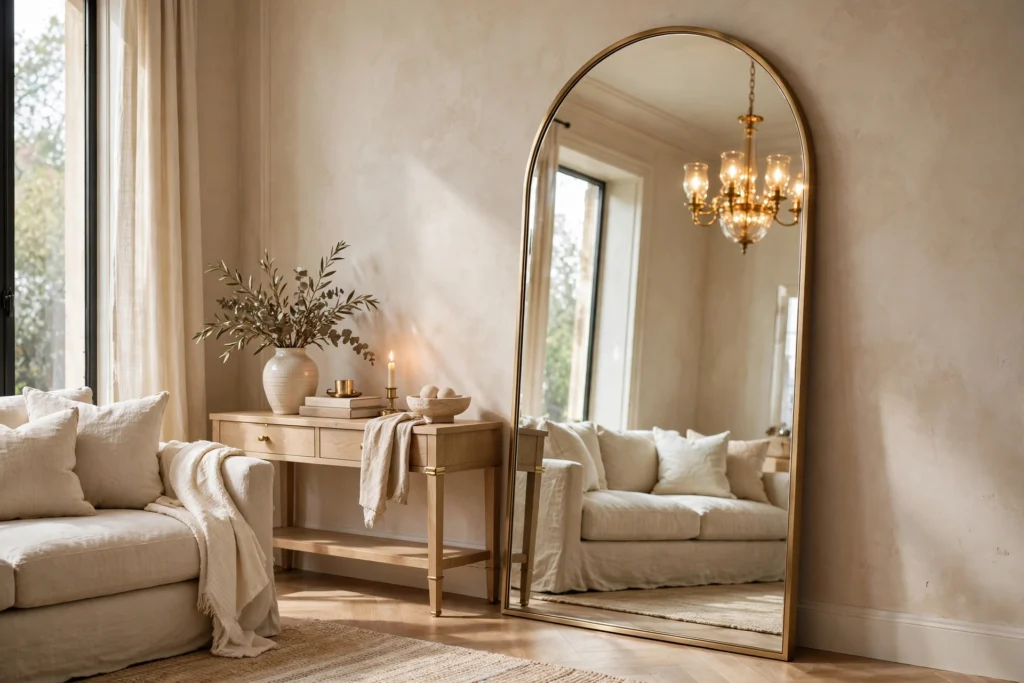
The single highest-impact mirror move: a floor mirror at least 170–180 cm tall, leaned against the wall at a slight angle rather than hung. Leaning reads relaxed and editorial; hanging the same mirror reads formal. The lean also tilts the reflection slightly downward, catching more of the room and less of the ceiling.
Place it where it earns its footprint: opposite or adjacent to a window (so it bounces daylight deep into the room), at the end of a hallway, or in a bedroom corner. In a living room, a leaned floor mirror beside a bookshelf or fireplace turns dead corner space into a light source.
How to do it: Budget $300–$1,500 for a quality oversized floor mirror (180 × 80 cm is the sweet spot); designer pieces with brass or blackened-steel frames run $2,000+. Always anchor the top to the wall with a discreet bracket or anti-tip strap — a 180 cm mirror is heavy and a real hazard in homes with kids or in earthquake-prone areas. The lean angle should be just 5–8 degrees; more looks sloppy.
2. Antiqued Mirror Panels: Instant Age & Depth
Antiqued (foxed) mirror — glass with a deliberately mottled, cloudy patina — is the luxury shortcut to a room that feels collected over decades rather than decorated last month. It reflects softly, so it’s forgiving in rooms where a crisp mirror would feel harsh, and its smoky depth makes it read almost like art.
Use it where flat mirror would be too much: as wardrobe door fronts, as a backsplash behind open kitchen shelving, as panels inside a bookcase back, or as a full feature wall in a dining room. In bathrooms, antiqued mirror above the vanity hides water spots far better than plain glass.
Designer tip: True hand-antiqued mirror runs $150–$400 per square foot custom-made; convincing manufactured antiqued mirror costs far less at $40–$90 per square foot. For a standard 120 × 90 cm vanity panel, expect $300–$800. Never use antiqued mirror where you need a true reflection (a dressing area) — its whole point is atmosphere, not accuracy.
3. Backlit Mirrors: The Floating Glow
A backlit (halo) mirror — LED strips hidden behind the glass so light spills softly onto the wall around it — is part mirror, part light fixture. In a bathroom it gives the most flattering light in the house (even, shadowless, from all sides); in a living room or bedroom, a round backlit mirror becomes a glowing focal point after dark.
The luxury is in the details: choose 2700–3000K warm LEDs (cool white backlighting looks clinical), and put the light on a dimmer or motion sensor. Frameless backlit rounds are the modern classic; backlit rectangles with softly rounded corners suit contemporary bathrooms.
How to do it: Quality backlit mirrors run $200–$800 depending on size (60–120 cm diameters are standard); custom sizes and demister pads (which keep the mirror fog-free) add $100–$200. Hardwire it to a wall switch rather than relying on a touch sensor alone — sensors fail, switches don’t. Budget an electrician $150–$300 for the connection if there’s no existing wiring.
4. The Brass-Framed Round Mirror: The Modern Classic
If luxury mirror ideas had a uniform, it would be the round mirror in a thin brass frame. It works over consoles, mantels, vanities, and beds; it softens rooms full of rectangles; and brass warms up every palette from greige to deep green. It’s the safest statement in this entire list — which is exactly why designers specify it constantly.
The difference between a $60 version and a $600 one: the frame’s finish (real brass or quality brass-effect vs. shiny plastic-gold), the glass quality (low-iron glass has no green edge tint), and the proportions (a thin 2–3 cm frame reads modern; chunky frames read traditional).
Designer tip: For a console 140–160 cm wide, choose a 90–100 cm diameter mirror. Budget $250–$900 for a well-made brass round mirror; unlacquered brass (which develops a patina) costs more but ages beautifully. Hang it 10–15 cm above the console surface, centered. If the room already has chrome or black hardware, a brushed-brass mirror still works — mixed metals are a designer signature, not a mistake.
5. The Full Mirror Wall: Maximum Drama
One wall of mirror — floor to ceiling, panel to panel — is the most dramatic thing you can do with glass. It doubles the room visually, bounces window light across the entire space, and at night reflects candlelight and lamps into something magical. Dining rooms are the classic location; small living rooms and home gyms are the practical ones.
The luxury execution matters enormously: use large panels (120 × 240 cm minimum) with minimal joints, align the joints symmetrically, and consider a smoked bronze or grey tint instead of clear — tinted mirror reads intentional and moody where clear can read “dance studio.” Antiqued full walls are the ultimate old-money move.
How to do it: Installed mirror wall runs $100–$250 per square foot including the glass, backing, and labor — a 3 × 2.5 m wall lands around $8,000–$20,000. Panels must be safety-backed (a film that holds shards if broken) — this is code in many places and non-negotiable. Keep furniture 30–40 cm off the glass so the reflection has depth, and never put a mirror wall where it reflects a TV (the double image is maddening).
6. Venetian Etched Mirrors: Heirloom Glamour
The Venetian mirror — hand-etched with floral and scroll motifs, often with beveled edges and a gently distressed finish — is old-world glamour that no modern piece can imitate. One above a mantel or in an entryway instantly gives a new-build home a sense of history. It pairs beautifully with contemporary furniture, where its ornament becomes the contrast.
Authentic hand-made Venetian mirrors are artisan pieces; good reproductions capture 80% of the effect at a fraction of the price. Either way, let it be the star — don’t crowd it with gallery walls or busy wallpaper.
How to do it: Genuine artisan Venetian mirrors start around $800 and run to $3,000+ for large pieces; quality reproductions cost $200–$600. These mirrors are heavy and fragile — professional hanging ($100–$200) is money well spent. Keep the palette around it quiet: the etching is the pattern, so the wall should be a calm plaster, limewash, or solid color.
7. The Arched Mirror: 2026’s Defining Silhouette
The arch is the defining shape of mid-2020s interiors, and the arched mirror is its purest expression — soft, architectural, and flattering to every room. A tall arched floor mirror makes ceilings feel higher; an arched mirror over a vanity softens all the bathroom’s hard rectangles; a pair of arched mirrors flanks a bed better than any art.
Black metal arches read modern-industrial; brass or gold arches read soft luxury; frameless arches (with a polished edge) read minimal. The arch’s curve does the decorating, so the frame can stay quiet.
Designer tip: A 170 × 60 cm arched floor mirror runs $200–$700 depending on frame material. For vanities, the arch should be 10–15 cm narrower than the vanity on each side. Lean full-length arches; hang smaller ones. The arch trend has been strong since 2022 and shows no sign of fading — this is a safe long-term choice, not a fad buy.
8. Mirrored Furniture: Reflection as Material
Mirrored consoles, side tables, and nightstands bring the mirror’s light-bouncing power down to furniture scale. A mirrored console in an entryway doubles the impact of every lamp and flower arrangement placed on it; mirrored nightstands make a small bedroom feel twice as wide. They’re also the easiest mirror idea to add to a finished room — no hanging, no wiring.
The caveat designers always give: mirrored furniture shows every fingerprint and dust speck, so it’s best in lower-touch spots (an entryway console beats a coffee table). Antiqued mirrored furniture hides smudges far better than plain.
How to do it: Budget $400–$1,200 for a quality mirrored console; nightstands run $250–$600 each. Check the construction — real mirrored furniture uses glass panels over a solid frame; cheap versions use reflective film that scratches and peels. In bedrooms, pair with soft textiles to balance all that hard reflection.
9. The Entryway Mirror Moment
The entryway is where a mirror works hardest: it’s the first thing guests see, the last thing you check before leaving, and usually the darkest spot in the house. The classic luxury formula is a console table + an oversized mirror above it + a lamp or sconces flanking it. The mirror doubles the lamp light; the console grounds the composition; a small stool or basket underneath finishes it.
Round mirrors soften narrow entryways; a tall rectangle makes a low hallway feel taller. If the entry faces the front door directly, check what the mirror reflects when the door opens — you want the interior, not the street.
Designer tip: Total budget for the moment: $500–$2,000 (mirror $250–$900, console $200–$800, lighting $100–$400). The mirror should be about two-thirds the console’s width. Add one living thing — a stem of eucalyptus, a small orchid — and the reflection doubles it for free.
10. Bathroom Mirrors: Frameless, Double & Considered
Bathroom mirrors deserve the same design attention as any other room. The luxury baseline: one large mirror per sink (not one small mirror stretched across two), frameless or thin-framed, with lighting that flatters — sconces at eye level on both sides beat a single overhead bar every time.
For double vanities, two matching mirrors (round or arched) read far more expensive than one wide rectangle. A full-wall mirror behind a floating vanity makes a small bathroom feel palatial. And in a luxury washroom, consider extending the mirror wall-to-wall above the vanity — the seamless reflection is pure hotel.
How to do it: Frameless custom bathroom mirrors run $15–$40 per square foot cut to size; a pair of 70 cm backlit rounds costs $400–$1,200. Mount sconces 160–170 cm high, flanking each mirror 10–15 cm from its edge, at 2700K. If you want the fog-free luxury, add demister pads ($50–$100 per mirror) — they wire to the lighting circuit.
11. The Mirrored Alcove: Architecture That Glows
For the truly committed: line an alcove, niche, or the inside of a bookcase with mirror. A mirrored alcove behind a bar turns every bottle into two; mirror inside a fireplace surround (where the firebox was) creates impossible depth; mirrored niche shelves in a bathroom make toiletries look curated.
This is a custom job — mirror cut to fit, safety-backed, installed by a glazier — but it’s the kind of detail guests photograph. Keep the objects in front of it minimal and beautiful; the mirror multiplies whatever’s there, good or bad.
Designer tip: Budget $500–$2,000 per alcove depending on size and complexity. Bronze-tinted mirror inside bars and bookcases reads warmer and more expensive than clear. Light the alcove — a small picture light or LED strip — and the mirror will do the rest.
12. The Curated Mirror Gallery Wall
One mirror is a reflection; five mirrors are a collection. A gallery wall of mixed mirrors — different shapes, sizes, and frames united by one finish family (all brass, all black, all wood) — turns a hallway or stairwell into a destination. It works because the variety keeps the eye moving while the finish family keeps it coherent.
The trick is planning: lay the arrangement on the floor first, photograph it, then transfer to the wall. Vary shapes (round, arch, rectangle, oval) but keep 2–3 cm gaps consistent. Odd numbers (5, 7) compose better than even.
How to do it: Budget $300–$1,000 total using a mix of vintage finds and new pieces — this is the idea where flea markets beat showrooms. Use proper wall anchors for every piece (galleries fail one weak hook at a time). Hallways are ideal: the mirrors bounce light down the corridor’s length and make it feel twice as wide.
Frequently Asked Questions
Where should you never put a mirror?
Three places: facing the front door (it bounces energy — and guests — right back out, and practically it reflects the street), facing another mirror (the infinite tunnel effect is disorienting), and reflecting clutter (a mirror doubles mess, so it should only face your best angles). Also avoid placing a mirror where it catches harsh direct sun — the glare is blinding rather than beautiful.
What size mirror goes over a console table?
Roughly two-thirds the width of the console — a 150 cm console wants a 90–100 cm mirror. Height-wise, leave 10–15 cm between the console top and the mirror’s bottom edge, and center the mirror at eye level (about 150–160 cm from the floor). When in doubt, go bigger: an oversized mirror over a console looks intentional, an undersized one looks like an afterthought.
Do mirrors really make a small room look bigger?
Yes — it’s the oldest designer trick in the book, and it works two ways. A mirror literally doubles the visible space by reflection, and more importantly it doubles the light, which is what actually makes rooms feel larger. The effect is strongest when the mirror reflects a window or light source. One large mirror outperforms several small ones for this purpose.
How do you clean a luxury mirror without streaks?
Microfiber cloth, slightly damp with distilled water and a drop of dish soap — never paper towels (they leave lint) and never ammonia-based cleaners on antiqued or tinted mirrors (ammonia can damage specialty finishes). Wipe in a Z-pattern rather than circles, and buff dry with a second clean microfiber. For backlit mirrors, clean with the light off so you can actually see the streaks.
Antiqued mirror vs. plain mirror — which is more luxurious?
Neither is “more” luxurious — they do different jobs. Plain mirror maximizes light and space; antiqued mirror adds age, softness, and artistry. Plain suits modern minimal rooms; antiqued suits layered, traditional, or transitional rooms. Many designers use both in one home: plain in the bathroom for true reflection, antiqued in the dining room for atmosphere.
Explore more: Luxury Living Room Ideas, Bedroom Decor Ideas, Warm Modern Bedroom Ideas
[…] Practical tip: Hang it opposite or beside a window, never facing a blank wall or the television. What a mirror reflects is what it adds to the room. For placement ideas by room and shape, see our 12 luxury mirror ideas. […]
[…] Practical tip: Lean, don’t hang, an oversized floor mirror — angle it slightly and it reflects the room instead of the ceiling. For placement tricks for every room, see our 12 luxury mirror ideas. […]