
Introduction
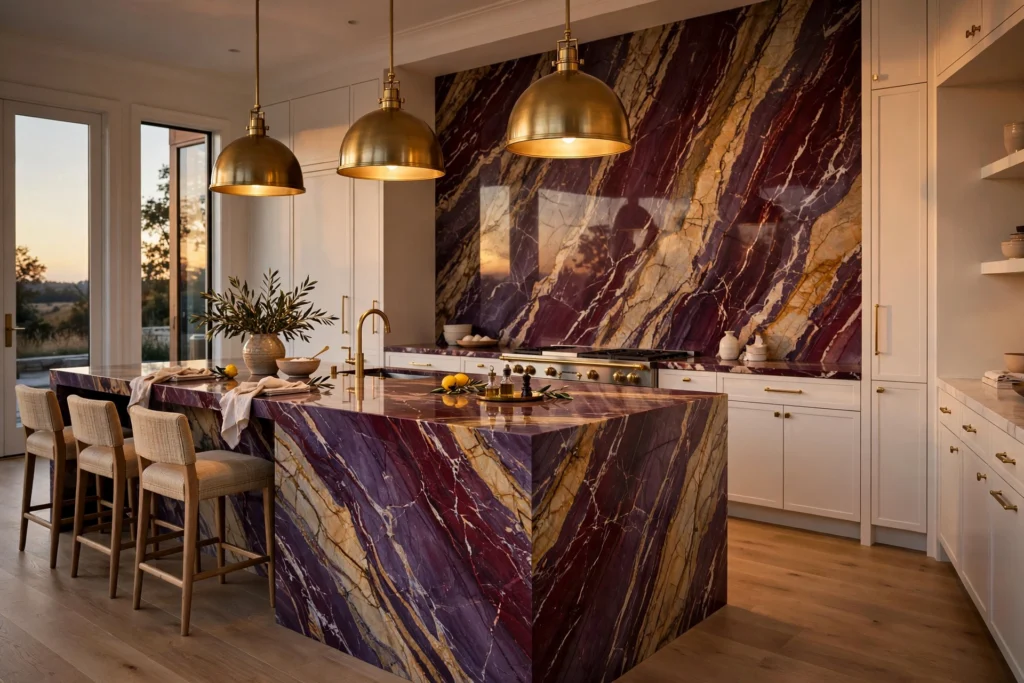
In 2026’s most striking kitchens, stone stopped being a surface and became the architecture. Not a countertop with a 10 cm upstand behind it, but entire walls of book-matched marble, islands whose sides pour to the floor in one unbroken waterfall, and backsplashes that run counter to ceiling as a single slab. The effect is immediate: the kitchen stops looking assembled from parts and starts looking carved from one idea.
This is the statement stone kitchen — a room where the natural material does the talking and everything else goes quiet. Cabinetry becomes a frame. Hardware disappears. Even the lighting gets out of the way, because when a three-meter slab of Calacatta Viola catches the morning light, it needs no assistance.
Below: how designers actually spec stone in luxury kitchens — slab sizes, costs, fabrication rules — and ten statement moves, from the classic waterfall island to the backlit onyx bar that turns a kitchen into a destination.
Stone 101: What Designers Know Before You Choose
Four principles before you fall in love with a slab:
- Slabs come in standard sizes — design to them. Most natural stone slabs measure roughly 300 × 150–190 cm (about 118 × 60–75 in). Book-matching doubles your visual width but needs two consecutive slabs cut from the same block. Know your wall’s dimensions first, then choose the layout — not the reverse.
- The finish changes the stone’s character. Polished finishes amplify drama and veining (and reflect light beautifully); honed finishes mute the pattern and read calmer, more contemporary. The same marble looks like two different materials in the two finishes. Always approve the finish on a full sample, not a 10 cm chip.
- Vein direction is a design decision. Veins running horizontally read calm and architectural; vertical or diagonal veining reads dramatic and sculptural. On a waterfall island, continuous veining that flows from the top down the side is the hallmark of top-tier fabrication — and it must be specified explicitly, not assumed.
- Stone needs the right support. Full-slab backsplashes and waterfall sides are heavy — a 3 cm marble slab weighs around 80 kg per square meter. Walls need proper backing, islands need structural cores, and overhangs beyond 30 cm need hidden steel supports. These are engineering decisions, not aesthetic ones, and they get made before the slab is cut.
Keep these in mind — every idea below assumes at least one of them.
1. The Waterfall Island, Done Properly
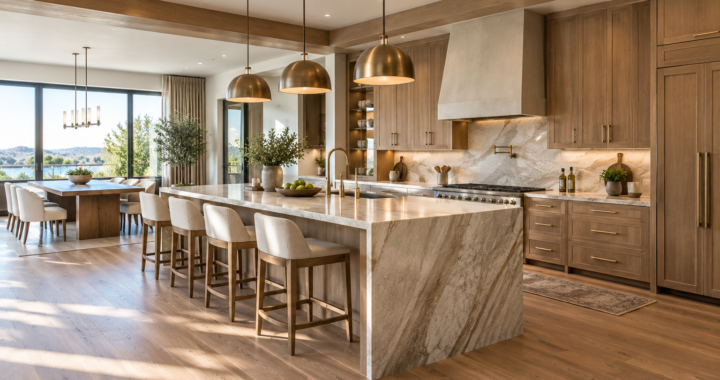
The signature move of the statement stone kitchen: the countertop continues down one or both sides of the island to the floor, so the stone reads as one continuous sculptural form. Done properly, the veining flows unbroken from the horizontal top into the vertical drop — the detail that separates a $30,000 island from a $60,000 one.
The craft is in the mitred edge: a true waterfall uses a 45-degree mitre joint so the pattern wraps the corner seamlessly, rather than a visible butt joint. Fabricators cut both faces from the same slab in sequence, so the veins align. Ask your fabricator to show you the vein-matching plan before cutting — a good one will have it drawn.
How to do it: Budget $15,000–$60,000+ for a full waterfall island in premium marble, depending on stone choice and island length (most luxury islands run 3–3.6 m long). The island core is typically plywood or MDF on a steel frame; the stone is a 2–3 cm skin. Both sides waterfalling doubles the stone cost but delivers the full sculptural effect. Plan the seam positions with your fabricator: the best waterfalls have no visible seam on the drop at all.
2. Full-Slab Backsplash: Counter to Ceiling
The most transformative single change in a kitchen renovation: replacing a tiled backsplash with one full-height slab of the same stone as the countertop, running from counter to ceiling — or at least to the underside of the upper cabinets. No grout lines, no pattern breaks, just an unbroken plane of stone behind everything.
It works because it removes visual noise. Grout grids chop the wall into hundreds of small pieces; a slab makes the wall read as one calm surface, which is exactly what a statement stone wants. It’s also the most practical backsplash in existence — no grout to stain behind a range, just wipeable stone.
Designer tip: Match the countertop stone, but consider switching the finish — a honed countertop with a polished full-slab backsplash (or vice versa) creates subtle depth without introducing a second material. For a 3 m wall in mid-range marble, budget $4,000–$10,000 installed for the slab plus fabrication. Where a range sits, many designers extend the slab behind the hood for a dramatic full-wall moment.
3. Book-Matched Marble Feature Wall
Book-matching — opening two consecutive slab cuts like a book so the veining mirrors symmetrically — is the most theatrical thing you can do with stone. A book-matched pair behind an island, flanking a range, or across the entire cook wall turns the kitchen’s hardest-working surface into its artwork.
The magic only works with strongly veined stones: Calacatta Viola with its dramatic burgundy veining, Arabescato with bold grey movement, or dark stones like Port Laurent with gold veining. Quiet stones (Carrara, most travertines) book-match invisibly and waste the technique — and the money.
How to do it: Book-matching needs two sequential slabs from the same block — reserve them at the stone yard, don’t assume availability. Fabrication and installation run 30–50% above standard slab work because every cut is sequenced and every vein alignment is checked. For a 3 × 2.5 m feature wall in Calacatta Viola, expect $12,000–$25,000 installed. Insist on seeing the dry layout before anything is fixed.
4. Calacatta Viola: The 2026 Power Stone
Pinterest searches for “Calacatta Viola marble kitchen” are up 260% — and for once the hype is justified. Quarried in Italy, Viola pairs a warm white-to-cream ground with dramatic veining in burgundy, violet, and gold. It’s the stone for kitchens that want warmth AND drama, where plain Calacatta Gold reads too cold and dark marble reads too heavy.
Viola demands confidence in application. A small dose — a pastry station top, a coffee bar backsplash — reads as an accent; the full statement is the island plus backsplash in the same stone, with quiet surroundings (warm white or pale oak cabinetry) to let it perform. The classic pairing is unlacquered brass hardware and warm 2700K lighting, which pulls the gold veining forward.
How to do it: Calacatta Viola slabs run $150–$350+ per square foot for the stone alone, roughly 2–3× standard Carrara. Because veining varies enormously between blocks, always select your actual slabs in person or via full-slab photos — never from a sample chip. Seal it properly (impregnating sealer, resealed annually) and it handles kitchen life fine; marble’s softness is a patina story, not a failure story.
5. Backlit Onyx: The Evening Kitchen
Onyx is translucent — light passes through it — which makes it the only stone that changes character after dark. Backlit onyx panels behind a bar, as an island front, or as a full backsplash glow like amber when lit, turning the kitchen’s evening mood from task lighting to atmosphere. No other material does this.
The technique is straightforward but unforgiving: the onyx (typically 2 cm) mounts in front of LED panels, and the stone must be selected for consistent translucency — dense patches will show as dark spots. Backlight color temperature matters enormously: 2700–3000K warm light flatters onyx’s honey and amber tones; cool light kills it.
Designer tip: Budget $200–$400+ per square foot installed for backlit onyx, including the lighting system. Use it as ONE feature — a bar front or a single wall — not everywhere; ubiquity kills the drama. Put the backlight on a separate dimmer circuit so the kitchen can shift from bright cooking mode to glowing evening mode. This is the move for kitchens that entertain.
6. Honed Travertine: Quiet Luxury in Stone
Not every statement shouts. Honed travertine — filled, matte, warm — delivers the statement stone kitchen for people who find marble too formal. Its pitted, layered texture (even when filled) catches light softly, and its warm beige-to-silver tones pair beautifully with limewashed walls, pale oak, and unlacquered brass. It’s Mediterranean calm at luxury scale.
The 2026 version is large-format: full slabs on the island and backsplash, not the small tiles of 2000s Tuscan kitchens. Modern travertine selection favors cleaner cuts (Classico, Navona) over heavily pitted rustic grades, and the honed finish keeps it contemporary. It’s also the most forgiving luxury stone — etching and wear blend into its natural variation.
How to do it: Travertine runs $80–$180 per square foot installed — the most accessible statement stone. Specify “filled and honed” for kitchen use; unfilled travertine’s open pits trap food and grease. Seal twice on installation and annually after. Pair with warm, not cool, companions: the stone’s warmth fights with grey cabinetry and chrome.
7. Quartzite: Marble’s Tougher Twin
Quartzite looks like marble, performs like granite. Formed from sandstone under heat and pressure, it takes a polish and veining remarkably similar to marble — Taj Mahal quartzite’s soft gold veining is nearly indistinguishable from Calacatta Gold — but with the hardness and acid resistance that marble lacks. Lemon juice, wine, and tomato sauce, the holy trinity of marble anxiety, don’t etch it.
This makes quartzite the practical designer’s statement stone: the full drama of a waterfall island and slab backsplash without the patina contract. It’s the right answer for serious cooks who want a show kitchen they can actually cook in — which, done well, is every kitchen.
How to do it: Quartzite runs $100–$250 per square foot installed. Critical: verify it’s TRUE quartzite, not “soft quartzite” (some marketed stones, including some Taj Mahals, are softer dolomitic marble — ask for the geological classification, not the trade name). Fabrication is harder than marble (it blunts blades), so use a fabricator experienced with the material. Seal annually as with any natural stone.
8. The Stone Range Hood: Carved, Not Clad
The range hood is the kitchen’s natural focal point — and the statement stone kitchen treats it as sculpture. Instead of a metal box or plaster form, the hood is built from the same stone as the island or backsplash: a monolithic carved form, a tapered slab construction, or a full-height stone chimney breast.
The tapered slab hood is the most achievable: 2 cm stone panels mitred into a trapezoid form, floating over the range with a hidden steel structure. The monolithic version — a single carved block — is a $20,000+ commission piece. Either way, the rule is material continuity: the hood in the island’s stone makes the room feel designed as one gesture.
Designer tip: Stone hoods need engineering — a 2 m stone chimney can weigh 300+ kg. The ceiling structure and a concealed steel frame carry it; the stone is the skin. Ventilation ducting runs inside the form. Budget $8,000–$25,000 depending on stone and complexity. Keep the hood’s stone quiet if the island is dramatic (or vice versa) — two shouting stones is one too many.
9. Thick Mitred Edges: The 5 cm Lie
Here’s a trade secret: most “thick” stone countertops are an illusion. A 5–6 cm edge profile is mitred from 2 cm slab — the front edge is laminated and polished to read as a massive slab, while the field stays standard thickness. You get the visual weight of a 5 cm top at a fraction of the stone cost and weight.
The mitre must be perfect — a visible seam line or lippage at the edge ruins the illusion instantly. This is a fabrication quality test: ask to see a fabricator’s mitred edge samples before committing. On waterfall islands, the thick edge continues down the drop for a monolithic read. On perimeter counters, it gives the stone presence without the structural demands of true 5 cm slab.
How to do it: Mitred edges add roughly $50–$100 per linear foot over standard eased edges. Specify the mitre explicitly in the fabrication drawings — “2 cm slab, 5 cm mitred edge, vein-matched” — and confirm the adhesive is color-matched resin, not visible glue. The thick edge pairs best with simple cabinetry; ornate doors plus thick stone fight for attention.
10. Terrazzo: The Patterned Statement
Terrazzo — chips of marble, quartz, and glass set in cement or resin — is the statement stone for kitchens that want pattern, not veining. Modern terrazzo goes big: large aggregate (2–5 cm chips) in dramatic colorways, poured or slabbed across islands and full-height backsplashes. It’s graphic, joyful, and completely unlike the quiet luxury of marble.
The 2026 terrazzo kitchen usually commits fully: island, backsplash, and sometimes floor in the same large-chip terrazzo, with the simplest possible cabinetry (flat fronts, warm white) as a frame. Dark terrazzo with light chips reads dramatic and modern; light terrazzo with colored chips reads playful Mediterranean.
How to do it: Slab terrazzo runs $70–$150 per square foot installed; poured in-situ terrazzo (seamless, no joints) runs higher but delivers the ultimate monolithic look. Resin-based terrazzo suits kitchens better than cement-based (less porous, easier to seal). Large chips show variation dramatically — approve full slabs, and accept that no two square meters will match. That’s the point.
Common Mistakes to Avoid
1. Choosing the stone from a sample chip. A 10 × 10 cm sample tells you nothing about a 3 m slab’s veining, movement, or color variation. Always approve full-slab photos or, better, visit the yard. The most expensive stone mistake is loving the chip and hating the slab.
2. Forgetting the engineering. Full-slab backsplashes need proper wall backing, waterfall islands need structural cores, stone hoods need steel frames. Stone is heavy and unforgiving — the structure gets designed before the slab is ordered, not after it arrives.
3. Two shouting stones. One statement stone per kitchen. A Calacatta Viola island plus a book-matched Arabescato wall plus terrazzo floors is not maximalism, it’s chaos. Pick your hero, then make everything else quiet.
4. Ignoring seam placement. Slabs have fixed sizes; walls and islands don’t. Where seams fall determines whether the stone reads as monolithic or pieced together. The seam plan is drawn with the fabricator BEFORE cutting — never left to installation day.
5. Skipping the dry layout. Book-matched pairs, waterfall vein flow, terrazzo chip distribution — all of these must be laid out and approved dry, before adhesive touches stone. Once it’s fixed, it’s fixed. The dry layout is the most important hour of the entire stone installation.
Frequently Asked Questions
How much does a statement stone kitchen cost?
The stone package (island + full-slab backsplash + fabrication) typically runs $20,000–$80,000+ in premium natural stone, on top of cabinetry. A waterfall island alone is $15,000–$60,000; a full-slab backsplash $4,000–$12,000; a book-matched feature wall $12,000–$25,000. Terrazzo and travertine sit at the lower end; Calacatta Viola and backlit onyx at the top.
Is marble practical in a real kitchen?
Honestly: marble etches and stains, and it will develop a patina. For many luxury owners that’s character, not damage — a lived-in Calacatta island tells a story. But if the idea of a lemon ring causes genuine distress, choose quartzite (marble’s look, granite’s performance) or porcelain slabs (the look, nearly zero maintenance). Know yourself before you choose the stone.
What’s the difference between marble, quartzite, and quartz?
Marble is metamorphosed limestone — soft, veined, etches with acid. Quartzite is metamorphosed sandstone — much harder, often marble-lookalike, acid-resistant. Quartz (engineered) is crushed stone in resin — consistent, non-porous, but lacks natural stone’s depth and can’t take heat the same way. For statement work, natural stone’s variation is the entire point.
Can I do a waterfall island with porcelain slabs?
Yes — large-format porcelain (up to 3.2 × 1.6 m) now mimics marble convincingly, costs $40–$90 per square foot installed, and is essentially indestructible. The trade-off: the pattern repeats (it’s printed), the edges show the printed layer on close inspection, and it lacks the depth of real stone. For rental properties or young-family kitchens, it’s the smart compromise.
How do I light a statement stone kitchen?
Light the stone, not the room. Under-cabinet LEDs wash a full-slab backsplash; pendants over a waterfall island should hang high enough not to block the view of the stone (75–90 cm above the counter); and 2700K warm light flatters nearly every natural stone. Avoid cool/blue lighting — it makes warm stones look grey and dead.
Does statement stone help resale?
A genuinely well-executed stone kitchen is one of the strongest resale features in luxury property — it photographs spectacularly and signals quality instantly. But taste is personal: the bolder the stone (Viola, onyx, dramatic terrazzo), the more it polarizes buyers. Classic choices (soft quartzite, honed travertine) have broader appeal than theatrical ones.
Final Thought
The statement stone kitchen works on a simple principle: one extraordinary material, used with total commitment, beats five nice materials used cautiously. The waterfall that flows unbroken to the floor, the backsplash with no grout line to interrupt it, the book-matched wall that stops guests mid-sentence — these aren’t decorations, they’re decisions. Choose the stone that moves you, engineer it properly, keep everything else quiet, and let geology do the designing.
Explore more: Luxury Kitchen Ideas · Natural Stone Bathroom Ideas
[…] more: Luxury Kitchen Ideas · Statement Stone Kitchen Ideas · Natural Stone Bathroom […]