
Introduction
The living room is the hardest-working room in the house. It’s where you land after a long day, where guests form their first impression, and where the family actually lives — which is why getting it right matters more than any other space. In 2026, luxury in the living room has shifted decisively away from showroom stiffness toward something more livable: deep comfort, honest materials, and restraint.
This guide covers 25 designer-tested luxury living room ideas for a sophisticated living room, each with the practical specifics most articles skip — the right measurements, realistic cost ranges, and the common mistakes that quietly cheapen a room. Use them as a checklist, whether you’re furnishing from scratch or elevating what you already own.
What Makes These Luxury Living Room Ideas Work?
Luxury is rarely about a single expensive item. It’s the result of five things working together: proportion (furniture sized correctly for the room), material honesty (real stone, real wood, real linen — not plastic imitations), layered light (never one overhead source), breathing room (edited, not crowded), and one or two moments of drama (a sculptural light, veined marble, oversized art). Get these five right and even a modest budget reads as expensive. Get them wrong and no amount of spending will save the room.
1. Choose a Statement Sofa
The sofa is the largest object in the room, so it sets the entire tone. For a standard 12×16 ft living room, aim for a three-seater between 84 and 96 inches wide with a seat depth of 22–24 inches — deep enough to lounge, shallow enough to sit upright comfortably. Performance fabrics (Crypton, Revolution) resist stains and fading far better than standard cotton, while top-grain leather patinas beautifully over a decade. Expect to spend $2,500–$8,000 for a genuinely well-built frame with feather-wrapped foam cushions; anything under $1,500 typically means a particleboard frame that sags within two years. Curved sofas are the 2026 silhouette of choice — their softer line breaks up boxy rooms. Common mistake: buying a sofa that’s too small for the wall. Your sofa should span roughly two-thirds of the wall it sits against, or the room will feel under-furnished no matter what else you add.
2. Create a Luxury TV Feature Wall
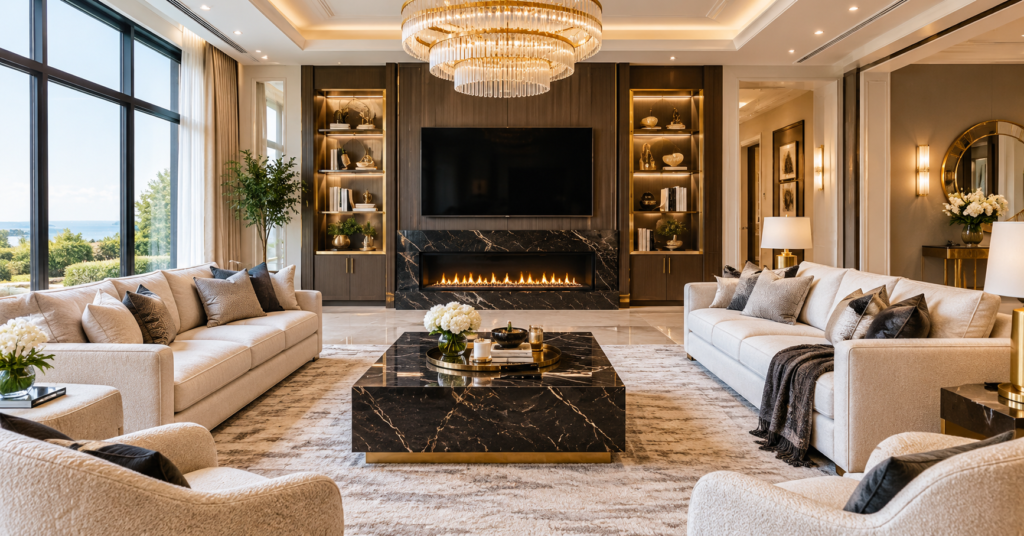
A TV wall earns its place as the focal point only if it’s designed as architecture, not an afterthought. The most effective treatments: fluted wood slat panels (white oak or walnut, slats 1–2 inches wide), book-matched marble or large-format porcelain slabs, or seamless microcement. Mount a 55–65 inch TV with its center 42 inches from the floor — eye level from a seated position — and add 2700K LED backlighting behind the panel for a soft halo that reduces eye strain. Budget $1,500–$6,000 depending on materials and whether you add built-in shelving. Two mistakes to avoid: mounting the TV above a fireplace (neck-craning height that ruins both) and glossy tile finishes that throw glare across the screen all afternoon.
3. Add a Modern Fireplace
Few things signal luxury like real flame — or its convincing modern equivalent. Linear electric fireplaces (50–72 inches wide) or ventless bioethanol burners integrate cleanly into a feature wall without chimneys or gas lines. Frame the firebox with black marble, honed travertine, or book-matched stone, and keep the surround’s proportions generous: a 60-inch firebox wants at least 8 feet of wall. Installed cost runs $2,000–$7,000 depending on the unit and stonework. Designer tip: recess the firebox flush with the wall rather than letting it protrude — the flush plane reads as architecture, the protruding box reads as appliance. Common mistake: a dinky 36-inch fireplace centered on a 14-foot wall, which looks lost and apologetic.
4. Use Neutral Colors
Neutrals are timeless because they let materials and light do the talking. Build on the 60-30-10 rule: 60% dominant neutral (warm white or greige walls), 30% secondary (beige upholstery, taupe rug), 10% accent (bronze, cognac, deep green). The critical detail is undertone — choose warm-leaning whites and beiges and keep them consistent, because a warm beige sofa next to a cool gray wall will fight all day. Always test paint swatches on the actual wall in both daylight and lamplight before committing. A full room repaint costs $200–$500 in materials. Common mistake: painting everything one flat beige with no tonal variation, which reads as rental-apartment bland rather than curated calm.
5. Add Elegant Accent Chairs
A pair of accent chairs completes the seating composition and introduces a second texture or color. Velvet in deep green, cognac, navy, or charcoal is the classic luxury move; bouclé reads softer and more 2026. Keep proportions honest: seat height 17–18 inches, overall width 28–32 inches — dainty chairs beside a deep sectional look like doll furniture. Swivel bases are worth the premium in open layouts since they let the chairs serve both the sofa conversation and the TV. Budget $600–$2,500 per chair for solid frames and quality upholstery. Common mistake: pushing accent chairs flat against the wall as decoration instead of angling them into the conversation zone where they belong.
6. Invest in a Statement Coffee Table
The coffee table is the visual anchor of the seating group, so size it like one: roughly two-thirds the length of your sofa, 14–18 inches high (an inch or two below the seat cushions), with 14–18 inches of clearance on all sides for legs and movement. Honed marble on a brushed-brass base is the enduring luxury formula; travertine or dark stained oak are warmer alternatives. Expect $700–$4,000 for real stone — composite “marble-look” tops are fine at lower budgets but check the edge profile, since a thick fake edge is the giveaway. Common mistakes: a tiny table marooned in front of a large sectional, and razor-sharp glass corners in a home with small children.
7. Layer Your Lighting: the Highest-Impact Luxury Living Room Idea
This is the single highest-impact upgrade on this list. Luxury rooms never rely on one overhead light — they build three layers: ambient (recessed cans or a chandelier on a dimmer), task (reading lamps, floor lamps beside seating), and accent (picture lights, LED strips behind shelving, a glow inside niches). Keep every bulb at 2700K warm white, and put dimmers on everything — a $15 dimmer switch does more for atmosphere than a $500 lamp. Size a chandelier by adding the room’s length and width in feet and converting to inches for the fixture diameter (a 12×16 ft room wants roughly a 28-inch fixture). Budget $1,000–$5,000 for a full layered scheme. The classic mistake is the “big light”: one harsh ceiling fixture blazing at full brightness, which flattens every material in the room.
8. Choose an Oversized Rug
An undersized rug is the most common living room error, and the fix is simple: go bigger than you think. For a standard seating group, a 8×10 ft rug is the minimum; 9×12 ft suits larger rooms. All front legs of the sofa and chairs should sit on the rug, with 12–18 inches of bare floor visible at the room’s edges. Low-pile wool or wool-blend rugs wear best and clean easiest; flatweaves suit high-traffic homes. Budget $800–$4,000 for a quality wool rug in these sizes — hand-knotted pieces start higher but last decades. Common mistake: the “postage stamp” rug floating under just the coffee table, which visually shrinks the entire room and disconnects the furniture.
9. Introduce Gold or Brass Details
Metallics are jewelry for the room — powerful in small doses, gaudy in large ones. Brushed brass (not mirror-shiny gold) is the 2026 finish of choice: introduce it through a chandelier, coffee table base, curtain rod, shelf brackets, and small objects like trays or vases. The cohesion trick is repetition — use the same finish in at least three places so it reads as intentional, and keep it to roughly 10% of the room’s visual weight. Brushed brass fixtures cost little more than standard chrome, so this is a budget-friendly upgrade. Common mistake: mixing chrome, polished gold, antique brass, and rose gold in one room. Pick one warm metal and commit; mixed metals only work when they’re clearly separated into zones.
10. Bring in Natural Materials
Natural materials are what separate “expensive-looking” from actually luxurious — the eye reads real wood grain and stone veining instantly. Anchor the room with white oak (flooring or a media console), travertine or marble (coffee table, fireplace), natural linen (curtains, upholstery), and leather (chairs, ottoman). The key balance: pair polished surfaces with matte, textured ones — a honed stone table beside a nubby wool rug, smooth leather against washed linen. This contrast is what keeps a neutral room from feeling flat. Costs vary widely, but even one real-material anchor (a solid oak console, a stone side table) elevates everything around it. Common mistake: an all-gloss room — lacquered furniture, polished floors, glass tables — which photographs well but feels cold and echoes in real life.
11. Use Floor-to-Ceiling Curtains
Curtains hung correctly make windows — and ceilings — look far grander than they are. Mount the rod 4–6 inches below the ceiling (or use a recessed ceiling track), and extend it 6–10 inches beyond the window frame on each side so the panels stack off the glass and don’t block light. Buy panels twice the window width for proper fullness, and let them just kiss the floor — pooling an inch or two reads luxurious, hovering an inch above reads like a mistake. Natural linen or linen-blend in a warm neutral is the luxury default; add blackout lining if it’s a media room. Budget $400–$2,000 per window depending on fabric and whether they’re custom. The classic error: a rod exactly as wide as the frame with skimpy panels that barely cover the glass.
12. Add Statement Artwork
One large piece of art does more than a gallery of small prints. Size it to the furniture below: roughly two-thirds the width of the sofa or console it hangs over, and center it at 57 inches from the floor (gallery height) — most people hang art far too high. Oversized abstract canvases in warm neutrals with one accent color are the safe luxury bet; a triptych works when a single canvas that size is out of budget. Original art from local artists ($300–$2,000) beats mass-produced prints every time and gives the room a story. Light it properly — a slim brass picture light ($80–$250) transforms even a modest piece. Common mistake: a tiny framed print lonely on a vast wall, hung at forehead height.
13. Create a Stylish Conversation Area
Arrangement is free, and it’s where most rooms fail. Pull the sofa and chairs off the walls — even 6–12 inches of breathing room changes the feel — and arrange seating so people face each other: an L, a U, or two sofas facing across the coffee table. Keep conversational distance tight: no more than 7–8 feet between facing seats, or people will shout. The coffee table should sit 14–18 inches from the sofa edge — close enough to set down a drink without standing. This one change costs nothing and instantly makes a room feel designed rather than assembled. Common mistake: every piece of furniture shoved against the perimeter like a waiting room, leaving a dead void in the middle.
14. Add Decorative Shelving
Built-in shelving is both storage and display, but only if styled with discipline. The formula designers use: fill roughly two-thirds of the shelf space and leave one-third empty — negative space is what reads as luxury. Group objects in odd numbers, mix orientations (some books vertical, one stack horizontal with an object on top), and repeat 2–3 materials (ceramic, wood, brass) for cohesion. Add slim LED strip lighting under each shelf ($30–$60 per shelf) — lit shelving looks custom at any budget. True built-ins cost $2,000–$8,000 depending on size and finish; a pair of tall bookcases flanking the TV wall achieves 80% of the effect. Common mistake: cramming every shelf edge-to-edge with small objects, which reads as clutter no matter how nice the individual pieces are.
15. Use Mirrors to Increase Visual Space
A large mirror is the cheapest way to double your light and visually expand a room. The rules: hang it where it reflects something worth seeing — a window, the chandelier, greenery — never a blank wall or clutter. A leaning floor mirror (65 inches or taller) in a slim brass frame is the current luxury staple; it needs no hanging hardware and its slight angle catches more light. In dining-adjacent living rooms, a mirror opposite the window can nearly double perceived daylight. Budget $300–$2,000 depending on size and frame. Two mistakes to avoid: a mirror that reflects the TV (glare and distraction) and mirrored furniture overload — one mirror is a trick of light, five is a funhouse.
16. Introduce Indoor Plants
Greenery is the fastest way to soften a polished interior and make it feel alive. Go big rather than scattering small pots: a 5–6 ft olive tree, fiddle-leaf fig, or kentia palm in a honed stone or ceramic planter anchors a corner like sculpture. Match the plant to your light — olives and figs want the brightest spot you have; kentia palms and ZZ plants tolerate lower light. Budget $100–$600 for a statement specimen plus planter, and water on a schedule (most indoor trees die from overwatering, not neglect). Common mistakes: a graveyard of tiny succulents scattered across surfaces, and cheap fake plants — if you go faux, invest in one high-quality stem, not a forest of shiny plastic.
17. Mix Different Textures
Texture is the secret behind rooms that look rich in a single color palette. Aim for three to five distinct textures in dialogue: velvet cushions, washed linen curtains, a wool rug, leather seating, honed stone, brushed brass. Run your hand across the room mentally — if everything feels the same (all smooth, all nubby), add the opposite. This is also the most budget-friendly luxury lever on this list: swapping flat cotton cushion covers for velvet or bouclé ($25–$60 per cover) transforms a sofa’s presence. The mistake to avoid is texture monotony — an all-leather, all-glass room feels like a car showroom, while all-soft textures with no hard edge feel unfinished. Contrast is the point.
18. Use Dark Accents for Contrast
An all-light room can feel washed out; dark accents give it backbone. Introduce charcoal, espresso, deep green, or navy at about 10–15% of the palette — a dark accent wall behind the TV, black window frames, an espresso media console, or deep-toned velvet chairs. Dark elements recede visually, which paradoxically makes the lighter pieces advance and glow. The cheapest version is paint: one dark wall costs $50–$150 in materials and an afternoon. Just respect your light: in a small, north-facing room, keep dark accents to furniture and objects rather than walls, or the space will feel cave-like. Common mistake: going half-dark — a single charcoal cushion in a sea of beige looks like a mistake, while committed dark accents look like a decision.
19. Keep the Layout Open
Luxury reads as space, and space is mostly about what you remove. Maintain 30–36 inch walkways between furniture groupings, keep 14–18 inches between the coffee table and seating, and allow 24 inches behind any chair someone needs to pull out. Before buying anything new, try removing one piece — most living rooms are one armchair or side table away from breathing properly. If the room must multitask (office corner, play zone), define zones with rugs rather than walls of furniture. This costs nothing and it’s the edit designers perform first in every consultation. Common mistake: the “furniture showroom” layout where every wall is lined and the center is an empty no-man’s land — or the opposite, a maze where you sidestep furniture to cross the room.
20. Add a Stylish Console Table
The console table is the hardest-working small piece in a living room: behind a floating sofa it hides the sofa’s back and gives you a surface for lamps; along an empty wall it creates a styled moment. Dimensions matter — 30–34 inches high, 12–14 inches deep, and roughly half to two-thirds the length of whatever it sits behind. Style it as a simple vignette: a table lamp (for that crucial lighting layer), one piece of art leaned against the wall, and a short stack of books with a small object on top. Then stop. Budget $400–$2,000 for solid wood or stone-topped consoles. Common mistake: treating the console as a storage shelf and loading it with remotes, chargers, and clutter — the moment it looks utilitarian, the luxury spell breaks.
21. Use Marble Carefully
Marble is unmistakable luxury, but it’s also high-maintenance — it etches with acids (wine, citrus, cleaners), so placement is strategy. Use it where it performs: coffee tables with coasters as a household rule, fireplace surrounds, side tables. Choose honed over polished for living areas — it hides etching far better and reads more contemporary. Limit marble to one or two surfaces per room; a marble coffee table, marble fireplace, AND marble side tables tip from luxurious to cold. Installed stonework runs $70–$200 per square foot. Common mistakes: marble everywhere (stunning in photos, stressful in life) and “marble-look” porcelain with an obviously printed pattern placed next to real stone — the fake always loses the comparison, so keep them in separate sightlines.
22. Create a Layered Neutral Palette
The difference between “beige room” and “layered neutrals” is deliberate tonal stepping. Build your palette from three to four related warm tones: warm-white walls, oatmeal upholstery, taupe rug, caramel leather, bronze metal. The non-negotiable rule is undertone consistency — gather fabric swatches and paint chips and view them together in daylight; if one skews pink, another yellow, and another gray, the room will never settle. This costs nothing beyond attention and it’s what separates designer rooms from furniture-store displays. Common mistake: the “greige drift,” where warm beige pieces accumulate alongside cool gray ones until the room feels muddy and indecisive rather than calm.
23. Focus on Comfortable Furniture
A living room you can’t relax in is a failed living room, however beautiful. Test the sit before you commit: seat depth 21–24 inches suits most adults, feather-wrapped foam cushions hold shape better than pure foam or pure down, and seat height around 17–18 inches works for conversation. For fabrics, performance weaves (look for 50,000+ double rubs on the spec sheet) survive kids and pets while still feeling good. This is where budget discipline pays: a $4,000 sofa you sink into daily beats a $4,000 sculpture you perch on. Common mistake: buying for the photograph — ultra-low, backless, or rigidly tailored pieces that look striking online and go unused in real life. The coziest luxury living room ideas always put comfort first.
24. Add Personal Decorative Pieces
The final layer that separates a designed room from a decorated showroom is personality — and it’s what makes living room decor feel like yours. Choose three to five meaningful objects — travel finds, a stack of art books you actually open, a family heirloom, a handmade ceramic — and give them prominent, uncrowded placement. Rotate them seasonally to keep the room feeling alive. Personal pieces work because they’re specific: a generic “live laugh love” sign adds nothing, but the brass compass from your grandfather’s desk makes guests ask questions. The discipline is curation: if everything is special, nothing is. Common mistake: the souvenir sprawl — twenty small travel trinkets scattered across every surface, which reads as clutter rather than character.
25. Choose Quality Over Quantity: the Golden Rule of Luxury Living Room Ideas
If there’s one principle behind every room on this list, it’s selectivity. Allocate your budget to four anchors that carry the room — sofa (~40%), rug (~20%), lighting (~20%), and art or coffee table (~20%) — and go quiet everywhere else. One $3,000 sofa transforms a room; six $500 accessories disappear into it. Buy the best frame, fabric, and craftsmanship you can afford for the pieces you touch daily, and save on the things at eye level only (vases, trays, books). Common mistake: spreading a $5,000 budget across twenty forgettable items instead of four memorable ones — the room ends up full and somehow still empty.
Frequently Asked Questions
How much does it cost to design a luxury living room?
A convincing result from these luxury living room ideas typically costs $8,000–$25,000 all-in, with the sofa, rug, and lighting consuming most of it. You can reach the look for $3,000–$5,000 by investing in those three anchors and keeping everything else quiet. The fastest way to waste money is spreading it thin — four excellent pieces beat twenty mediocre ones every time.
What colors make a living room look expensive?
Warm, layered neutrals: warm white, oatmeal, taupe, camel, and soft charcoal, with one metallic (brushed brass) and one deep accent (forest green, cognac, or navy). The key is undertone consistency — keep every neutral on the warm side. Mixed warm and cool neutrals are the most common reason a room feels “off.”
How do I make a small living room look luxurious?
Prioritize three things: scale (one properly sized sofa beats a loveseat plus clutter), light (mirrors opposite windows, layered 2700K lighting), and editing (fewer, better pieces with clear walkways). Light walls, one large rug, and floor-to-ceiling curtains will make a compact room feel twice its size.
What is the biggest mistake in living room design?
Buying furniture before planning the layout. Measure the room, tape out furniture footprints on the floor, and confirm walkways (30–36 inches) and clearances before ordering anything. Most expensive mistakes — the too-small rug, the oversized sectional, the TV wall that doesn’t fit — come from skipping this free step.
Final Thoughts on These Luxury Living Room Ideas
A sophisticated living room isn’t assembled from a shopping list — it’s composed from decisions about proportion, material, light, and restraint. Start with the layout (tape it out, protect your walkways), anchor the room with a great sofa, rug, and lighting plan, then layer in texture, art, and the personal objects that make it yours. Every idea in this guide works independently, so begin with the two or three that address your room’s weakest points and build from there. The result is a living room that doesn’t just look luxurious in photographs — it feels luxurious every evening you walk into it.
Explore more: Luxury Kitchen Ideas · Luxury Bedroom Decor Ideas · Luxury Modern Washroom Ideas
[…] key hallmark of modern architecture is the seamless flow between living, dining, and cooking areas. An Open-Plan Layout maximizes natural light and creates an inviting […]
[…] exploring our luxury design guides: luxury kitchen ideas, elegant living room designs, and modern washroom […]
[…] more luxury inspiration: our guides to luxury kitchen ideas, elegant living room designs, and serene bedroom […]
[…] more: Luxury Living Room Ideas, Bedroom Decor Ideas, Warm Modern Bedroom […]
[…] Luxury Living Room Ideas — statement pieces and layouts for the main gathering space […]
[…] look feel expensive rather than showroom-cold. If you want a full-room starting point, our guide to luxury living room ideas shows how these layers come […]
[…] start: nothing here is a flimsy trick. These are the same moves used in the rooms in our guide to luxury living room ideas — just executed with thrift-store patience, smart sizes, and discount-store timing instead of […]
[…] more: 25 Luxury Living Room Ideas for a Sophisticated Home · 15 Luxury Bedroom Ideas with Warm Modernism […]