Introduction
The luxury kitchen of 2026 looks nothing like the cold, all-white showrooms of a decade ago. Today’s most coveted kitchens are warm, tactile, and quietly intelligent: dramatic veined stone paired with white oak, lighting layered like a boutique hotel lobby, and technology hidden so well you forget it’s there. The defining shift is from “display luxury” — shiny surfaces meant to impress — to “lived-in luxury,” where every material earns its place through daily use.
What separates a truly luxurious kitchen from an expensive one is not the budget but the decisions: stone chosen for its veining, not just its price tag; lighting planned in layers rather than a single harsh grid; storage engineered so counters stay clear without effort. Below are 10 luxury kitchen ideas that deliver exactly that — each with the materials, measurements, and costs you need to plan it properly.
1. Premium Marble Countertops & Custom Cabinetry: the Anchor of Luxury Kitchen Ideas
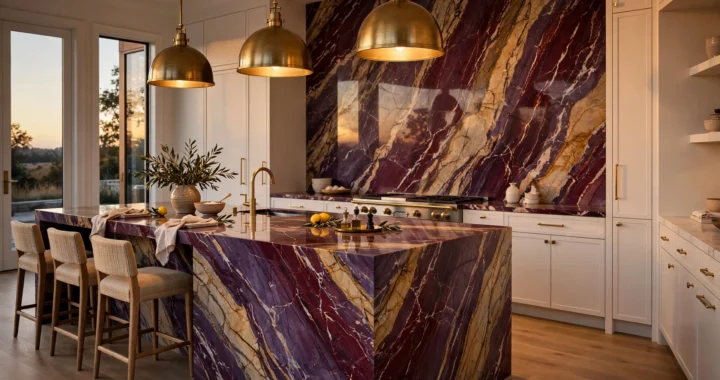
Nothing anchors a luxury kitchen like natural stone, and in 2026 the stones with the most personality win: Calacatta Viola with its dramatic burgundy-grey veining, classic Calacatta Gold, or moody Nero Marquina for contrast islands. Specify 3cm slabs with mitered edges for a thick, furniture-like profile, and choose a honed finish if you cook daily — it hides etching far better than polished. Expect installed marble at roughly $150–$300 per square foot depending on rarity, and seal it annually; marble stains if you ignore it, and that is the honest trade-off for its beauty.
Pair the stone with custom cabinetry — inset or frameless construction in white oak, walnut, or a muted olive lacquer — built to the ceiling with zero filler gaps. Custom runs typically cost $25,000–$60,000 for an average kitchen but buy you what stock cabinets never can: full-height storage, integrated panels, and soft-close everything. Common mistake: pairing busy marble with busy cabinetry. Let one be the star — dramatic stone wants quiet, flat-front cabinets.
2. Statement Pendant Lighting & Smart Appliances
Pendants over the island are the jewelry of the kitchen, so size them like it: each pendant’s diameter should be roughly one-third the island’s width, hung 30–36 inches above the countertop, in odd numbers (three over a standard 8-foot island). Globe pendants in smoked glass or alabaster warm the light; oversized brass domes make the architectural statement. Put them on dimmers — non-negotiable — and keep every bulb at 2700K–3000K so the kitchen glows amber in the evening instead of glaring white.
Complement the focal lighting with integrated smart appliances: a French-door refrigerator with a family-hub screen, a wall oven you can preheat from your phone, and a dishwasher so quiet (under 42 dB) you check whether it’s running. Budget $15,000–$30,000 for a full smart suite from brands like Bosch, Miele, or Thermador. Common mistake: pendants hung too high (they become ceiling decor) or smart features you’ll never use — prioritize app-controlled ovens and quiet dishwashers over gimmicks like interior cameras.
3. Spacious Open-Plan Layouts for a Grand Luxury Kitchen
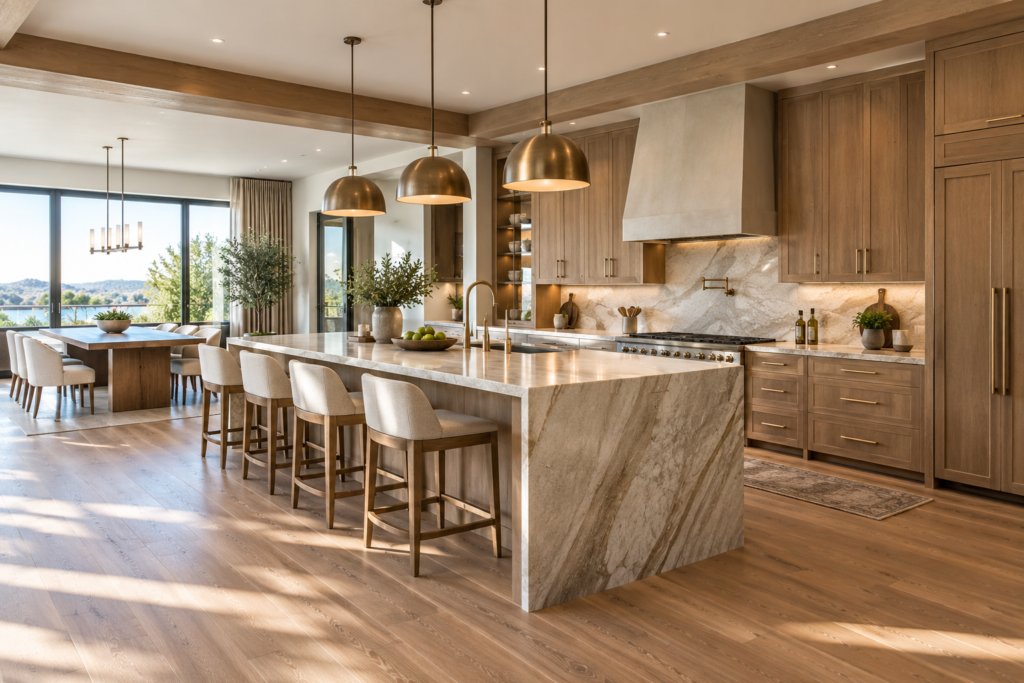
The luxury of space is the one money can’t fake, which is why open-plan remains the defining layout of high-end kitchens: cooking, dining, and living flowing together with no walls breaking the light. Plan it around work zones rather than the old triangle — a prep zone near the sink, a cooking zone around the range, and a serving zone by the dining area — with 42–48 inch aisles so two cooks pass comfortably. Anything under 40 inches feels cramped no matter how expensive the finishes.
Floor-to-ceiling windows are this layout’s best friend: a wall of glass facing the garden or skyline floods the stone and wood with natural light and makes even a modest footprint feel grand. If you’re removing a wall, budget $5,000–$15,000 for structural work (a steel beam and engineer sign-off are mandatory for load-bearing walls). Common mistake: open plans without acoustic planning — add soft furnishings, rugs, or acoustic plaster nearby, or every clatter echoes through the living room.
4. Intricate Mosaic Backsplash Designs
A backsplash is the kitchen’s canvas, and mosaic is where craftsmanship shows. Handmade zellige tiles with their imperfect glaze catch light like water; mother-of-pearl mosaics shimmer behind the range; small-format marble mosaics (herringbone or basketweave) add pattern without noise. Run the backsplash all the way to the ceiling behind the range hood — the standard 18-inch strip looks dated by comparison — and use epoxy grout, which resists staining far better than cement grout.
Installed cost runs $30–$100 per square foot depending on material, with zellige and mother-of-pearl at the top end. Common mistake: choosing a mosaic that fights the countertop. If your marble is dramatic, keep the backsplash quiet (a soft handmade-look ceramic); if counters are quiet quartz, let the backsplash be the art.
5. Double Kitchen Islands
In large kitchens a single island forces one surface to do everything — prep, cook, serve, seat — and it does none of them brilliantly. A double-island layout splits the roles: one island as the workhorse (sink, dishwasher, chopping space) and the second as the social hub (seating, wine service, display). You need at least 12 feet of kitchen width to pull this off with comfortable 42-inch aisles around both.
Make the entertaining island the showpiece: a waterfall edge in dark marble — Nero Marquina or a dramatic quartzite — creates a sculptural contrast against lighter perimeter cabinetry, and a sculpted or fluted front adds texture you can feel. Allow a 12–15 inch overhang for comfortable knee space at counter stools. Budget $8,000–$20,000 per island for stone and cabinetry. Common mistake: two islands in a kitchen that’s too narrow — measure twice, because islands closer than 36 inches apart turn luxury into an obstacle course.
6. Concealed Pantries & Hidden Storage: the Hallmark of Luxury Kitchen Ideas
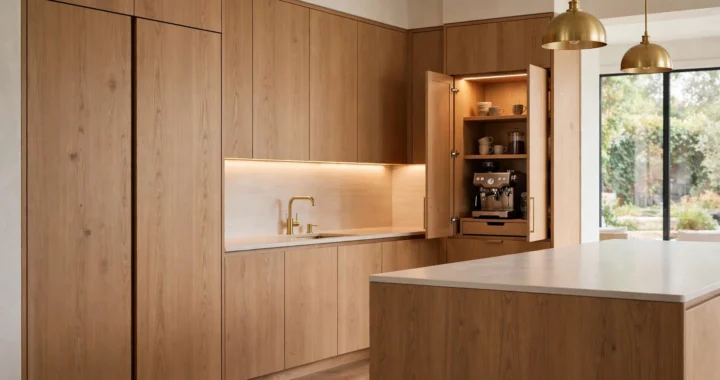
The hallmark of a luxury kitchen is what you don’t see: no appliance clutter, no cereal boxes, no knife blocks. A walk-in butler’s pantry behind the main kitchen — even a modest 6×8 foot room — absorbs the toaster, coffee station, stand mixer, and dry goods behind a closed door. No room for a walk-in? Appliance garages with pocket or tambour doors hide small appliances inside tall cabinets, and full-height pull-out larders keep every spice within arm’s reach.
This is also where minimalist styling earns its keep: with storage doing the heavy lifting, counters hold only three to five considered objects — a sculptural bowl, a cookbook stack, a small olive tree. Everything else lives behind panels. Budget $5,000–$15,000 for a well-fitted pantry. Common mistake: building the pantry but skipping interior lighting and outlets — a dark pantry with no plug for the coffee machine defeats its purpose. Wire it like a real room.
7. Integrated Wine Cellars & Beverage Centers
Entertaining at a luxury level means drinks are part of the architecture. A glass-front wine display — temperature-controlled at 55°F and 70% humidity — built into a wall or under the stairs turns a collection into art; backlight it softly and bottles become the room’s jewelry. For a simpler move, a dedicated beverage center: an under-counter dual-zone cooler (wine at 55°F, beer and mixers at 38°F) plus an ice maker, tucked into the entertaining island or bar wall.
Glass-front illuminated shelving extends the idea beyond wine — decanters, ceramics, and glassware become part of the design rather than clutter. Budget $3,000–$8,000 for a quality beverage center setup, $10,000+ for a true built-in cellar. Common mistake: storing wine in a warm kitchen cabinet — heat and vibration are wine’s enemies, so a proper cooling unit isn’t optional if the bottles matter.
8. High-End Fixtures & Touchless Faucets
Fixtures are the handshake of the kitchen — touched dozens of times daily — so they should feel as good as they look. Unlacquered brass develops a living patina that designers love (it darkens where touched most); matte black gives graphic contrast against marble; brushed bronze splits the difference. Match the faucet finish to cabinet hardware and the range hood trim for a composed, intentional look.
Touchless, sensor-activated faucets add genuine hygiene — wave a hand with raw chicken on it — and most quality models include manual override so you’re never stranded by a dead battery. Add a pot filler over the range if you cook pasta often; it’s a small luxury you will use weekly. Budget $800–$2,500 for a premium faucet setup. Common mistake: mixing four different metal finishes. Two is the limit — three only if one of them is a deliberate, repeated accent.
9. Professional-Grade Cooking Ranges
For serious home cooks, nothing signals luxury like a professional-style range: 36 to 48 inches wide, with high-BTU burners (18,000–23,000 BTU each) that sear properly and a bridge or griddle for weekend cooking. Choose dual fuel — gas cooktop for control, electric oven for even baking — or go full induction for the fastest, safest, most precise heat (and the easiest cleanup). Pair it with a custom range hood sized to the task: plan roughly 100 CFM of extraction per 10,000 BTU, and remember that powerful hoods need make-up air — many building codes require it above 400 CFM.
The hood itself is a design moment: a plastered chimney hood, a brass-trimmed canopy, or a sleek stainless sculptural form becomes the kitchen’s architectural centerpiece. Budget $8,000–$20,000 for range plus hood. Common mistake: buying pro power without pro ventilation — a 48-inch range under an underpowered recirculating hood will smoke out an open-plan home every time you sear.
10. Warm Natural Elements & Accent Lighting
Stone and steel can feel cold without counterweight, so the final layer is warmth: walnut shelving against marble, white-oak bar stools, a live-edge serving board leaning on the backsplash. Even small doses — a wooden fruit bowl, leather pulls on one bank of drawers — soften the room’s temperature dramatically.
Then light it like evening matters, because it does. Under-cabinet LED strips (2700K, high CRI 90+) wash the backsplash and make prep safer; toe-kick lighting floats the cabinetry after dark; a dimmer on every circuit lets the kitchen shift from bright work mode to candlelit dinner mode. Budget $2,000–$6,000 for a proper layered lighting plan. Common mistake: a single grid of recessed downlights — it flattens everything and casts shadows on your work surface. Layers, not grids.
Frequently Asked Questions
How much does a luxury kitchen remodel cost in 2026?
A true luxury remodel typically runs $75,000–$200,000+ depending on size and region. Cabinetry and stone usually consume 40–50% of the budget, appliances 20–25%, with the rest going to lighting, plumbing, flooring, and labor. The ideas above are modular — a $15,000 lighting and hardware refresh can transform a kitchen without touching the layout.
Is marble or quartz better for luxury kitchen countertops?
Marble wins on beauty and uniqueness — no two slabs are alike — but it etches and stains and needs sealing. Quartz wins on maintenance: it’s non-porous, consistent, and nearly indestructible, and high-end quartz now mimics marble veining convincingly. Choose marble if you love patina and don’t mind upkeep; choose quartz if you want luxury without the worry.
How do I keep an open-plan kitchen from smelling up the house?
Ventilation is everything: a properly sized ducted range hood (not recirculating) vented to the exterior, sized at roughly 100 CFM per 10,000 BTU of cooktop power. Add a quiet ceiling fan or heat-recovery ventilator for background air exchange, and choose an induction cooktop — it produces far less ambient heat and grease-laden air than gas.
Are smart kitchen appliances actually worth it?
The useful ones are: app-controlled ovens (preheat on your way home), dishwashers under 42 dB, and refrigerators with accurate temperature zones. Skip gimmicks like interior cameras and voice-ordering fridges unless you’ll genuinely use them. Buy smart for function and quietness, not novelty.
Final Thoughts on These Luxury Kitchen Ideas
A truly luxurious kitchen is not defined by one expensive material or a single design trend — it comes from the balance between form, function, texture, light, and personal style, which is the essence of great luxury kitchen ideas. Start with the decisions that are hardest to change later (layout, stone, cabinetry), layer in light and warmth, and hide everything that doesn’t deserve to be seen. Do that, and the result won’t just photograph beautifully — it will cook beautifully, every single day.
Explore more: Luxury Living Room Ideas · Luxury Bedroom Decor Ideas · Luxury Modern Washroom Ideas