“How much do I need to spend?” is the wrong first question. The right one is: “What should this exact amount buy me first?” A spare $150 spent randomly disappears into candles and cushions nobody notices. The same $150 spent in the right order — light, scale, texture — makes a room look deliberately designed.
This guide breaks luxury home decor ideas by budget into three real plans: $150, $500 and $1,500. Each tier gives you a room-by-room shopping list with real street prices, what to skip, and what changes when you move up. If you want the general principles first, start with our 12 luxury home decor ideas on a budget — this article is the spending plan that puts those principles into a cart.
The Golden Rule of Decor Budgets
Every tier below follows the same priority order, because expensive-looking rooms are built in this sequence:
- Light — warm, layered light is the single biggest luxury signal.
- Scale — fewer, bigger pieces beat many small ones.
- Texture — velvet, stone, brass and linen read as “expensive” at any price.
- Details — hardware, frames and styling come last, not first.
Buy in that order and even the smallest budget lands. Buy in reverse and even $1,500 looks like a yard sale.
The $150 Plan: The Room Reset
Best for: one room (usually the living room or bedroom) that feels flat and unfinished.
Shopping list (typical prices):
- Two warm-white LED bulbs, 2700K, for your main lamps — $10. Cold daylight bulbs are the #1 reason rooms look cheap; this $10 fix changes everything downstream.
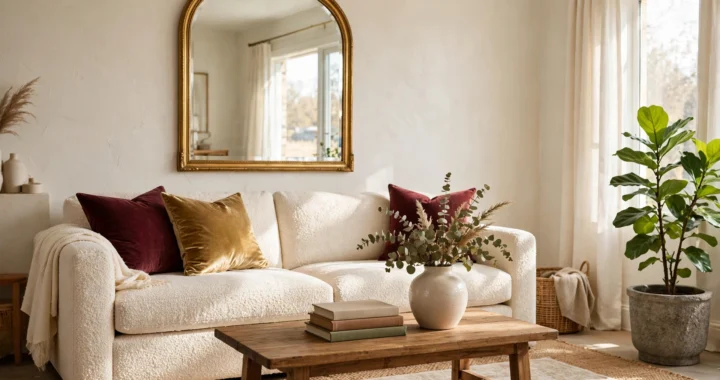
- One oversized mirror, 24×36 in or larger, thrifted or budget-line — $40–60. Lean it or hang it opposite a window to double the light. (Sizing rules here)
- Velvet cushion covers, set of 4, in one jewel tone — $25. Covers, not new cushions: same inserts, new skin.
- One large framed art print or a thrifted oversized frame with a printed poster — $30.
- A brass or marble-look tray for the coffee table — $15.
- One real plant in a heavy pot — $15–20.
Total: ≈ $145–155
What this buys you: a room that photographs well. Light is warm, one wall has scale (mirror + big art), and texture appears in the cushions and tray. What it does not buy: new furniture — and it doesn’t need to. At this tier, furniture arrangement matters more than furniture: pull the sofa off the wall, group seating around the rug, and clear every surface except the styled tray.
Skip at $150: scented candles in bulk, small knick-knacks, “decor sets,” and any furniture. Small objects are where small budgets go to die.
The $500 Plan: The Designer Layer
Best for: a full living room transformation, or living room + entryway.
Everything in the $150 plan, plus:
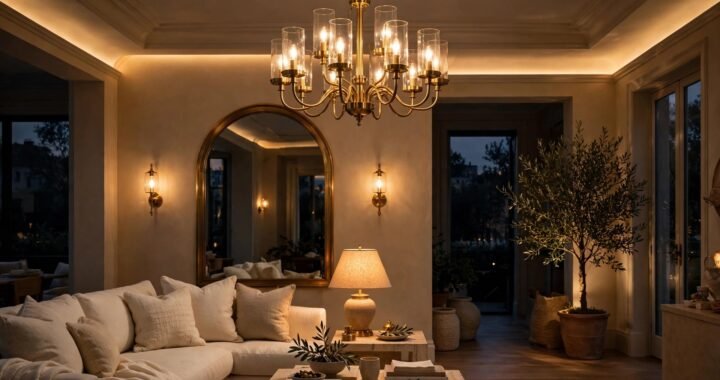
- A statement light fixture — a brass or sculptural chandelier, or a pair of plug-in wall sconces — $120–180. This is the tier’s hero purchase. Layered lighting is what separates designed rooms from decorated ones; our layered luxury lighting guide shows the exact chandelier + sconce + lamp formula.
- A larger rug, 8×10 ft, vintage-look or high-pile — $130–170. Rugs that are too small are the most common budget-decor mistake. Front legs of all seating must sit on the rug.
- Full-length curtains, hung high and wide — $60–80 for a pair with a simple rod. Hang the rod 4–6 inches above the frame and extend it 8–10 inches each side; the window instantly looks twice as grand.
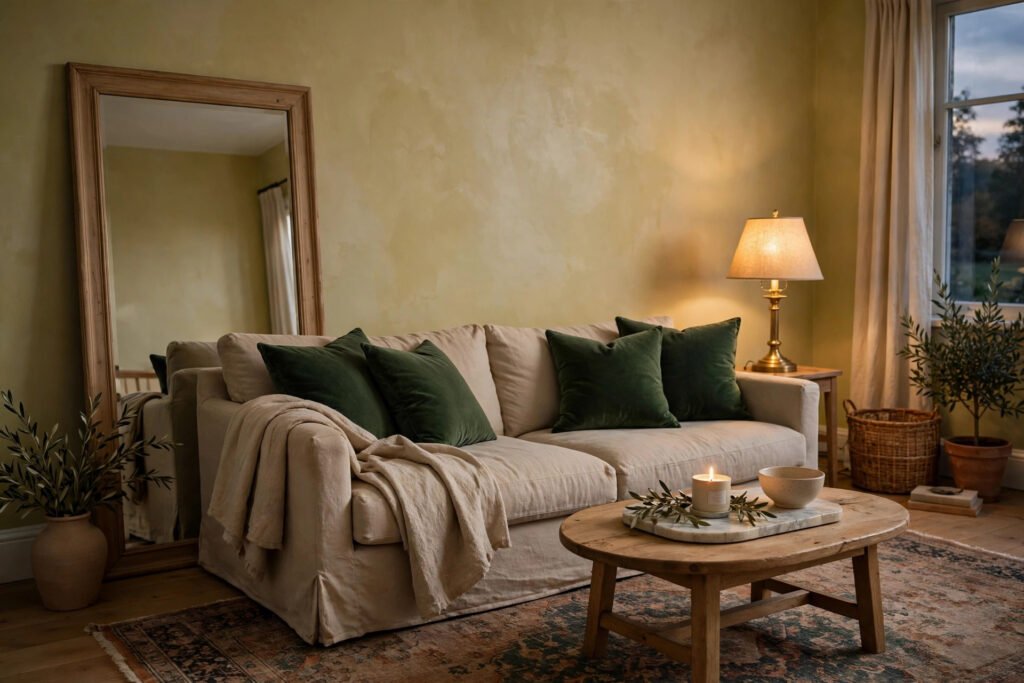
- A matched pair of table lamps with fabric shades — $60–80 the pair. Pairs create the symmetry that reads as “hotel luxury.”
- Fresh paint for one accent wall (limewash effect or a deep jewel tone) — $40–50 with supplies.
Total with the $150 base: ≈ $500–560
What this buys you: the full designer formula — layered light, correct scale, dressed windows. This is the tier where guests start asking which designer you used. If the $500 is all for the living room, our room-specific breakdown of luxury living room decor on a budget goes even deeper on this one space.
Skip at $500: a new sofa (save for the next tier jump or buy once, properly), matching furniture sets, and trendy small decor in this season’s fad colour.
The $1,500 Plan: The Statement Tier
Best for: living room + bedroom, finished to a “magazine” standard.
Everything above, plus one or two statement anchors:
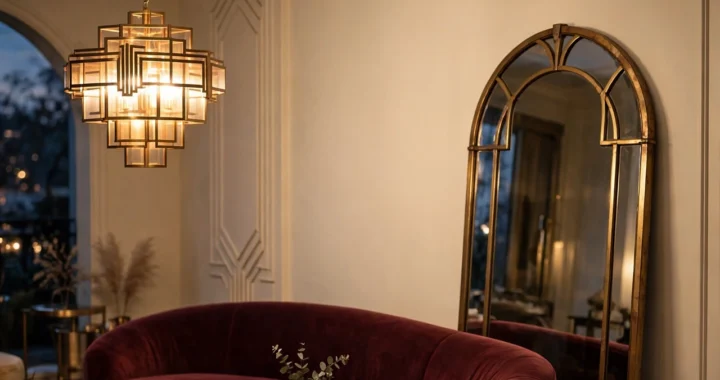
- One sculptural accent chair in velvet or bouclé — $350–500. A single curved, jewel-toned chair is the Neo Deco signature (the look driving luxury home decor trends in 2026) and instantly becomes the room’s focal point.
- A real stone side table or coffee table (marble, travertine) — $200–350 second-hand or flat-pack stone. Real stone weight and coolness cannot be faked up close.
- Bedding upgrade for the primary bedroom — crisp white or warm-cream layered bedding, a throw, two Euro shams — $150–200. Hotel-bed layering is the cheapest “luxury bedroom” signal there is; see how it anchors our warm modern bedroom ideas.
- Oversized art, professionally framed, 36×48 in or larger — $150–250. One big piece, not a gallery wall of small frames.
- Swapped hardware — brass cabinet pulls and door handles in the main rooms — $60–100. The jewellery of the house.
Total with the lower tiers: ≈ $1,450–1,600
What this buys you: permanence. Tiers 1 and 2 are styling; this tier adds real materials and furniture you keep for a decade. The room stops looking “decorated on a budget” and simply looks expensive.
Skip at $1,500: spreading it across five rooms. $1,500 split five ways is $300 of nothing per room. Finish two rooms completely instead.
Which Room First? The Priority Order
With any of these budgets, spend in this order:
1. Living room — where you live and host; biggest return per dollar.
2. Primary bedroom — the $150 tier alone transforms it (light + bedding + mirror).
3. Entryway — a mirror, a tray and one lamp: the cheapest “expensive first impression” in the house.
4. Bathroom — last, because the wins here (stone, fixtures) cost the most per square foot.
Where to Splurge vs Save (Quick Reference)
Worth the splurge: the light fixture, the rug (size, not brand), one real-material piece (stone, solid brass, real velvet).
Always buy budget: cushion covers, trays, frames, bulbs, paint, hardware, plants and pots.
Never buy at all: decor “sets,” tiny accessories in bulk, and anything whose only job is to fill a shelf.
5 Budget Decor Mistakes That Waste Money
1. Buying small. Ten $15 objects look cheaper than one $150 piece. Scale is luxury.
2. Cold light. 4000K+ bulbs make even real marble look like an office. Stay at 2700K.
3. Skipping the rug size rule. A 5×7 rug under an 8-foot sofa reads “student flat,” whatever it cost.
4. Matching everything. Matched sets look bought, not designed. Mix brass with black, velvet with linen.
5. Decorating before lighting. Accessories cannot fix a badly lit room. Light first, always.
FAQs
What is the cheapest way to make a room look luxurious?
Warm layered light (2700K bulbs + one lamp pair), one oversized mirror, and decluttered surfaces styled with a single tray. The full reset costs about $150 and is detailed in the first plan above.
Is $500 enough to redo a living room?
Yes — if you keep your sofa. $500 covers the designer layer: a statement light fixture, a correctly sized 8×10 rug, high-hung curtains and a lamp pair, on top of the $150 styling base.
Should I spread my budget across all rooms or finish one room?
Finish one or two rooms completely. Luxury reads as completeness — one fully resolved room impresses more than five half-done ones.
What single purchase makes the biggest difference?
The light fixture. A sculptural ceiling light or sconce pair changes how every other object in the room is perceived, because it changes the light itself.
Where do designers actually buy budget luxury pieces?
Marketplace and thrift stores for stone, brass and solid wood (heavy = quality); budget lines for textiles and bulbs; and one or two full-price hero pieces per room. Weight and material matter more than labels.
The Bottom Line
Luxury decor is not about the size of the budget — it is about the order of spending. $150 buys the reset, $500 buys the designer layer, and $1,500 buys permanence. Pick your tier, buy in the light-scale-texture order, and resist every small shiny thing in between. Your rooms will look like the budget was three times bigger — because it will look planned.
Ready to start? The $150 plan needs one weekend and one shopping trip. Begin with the bulbs.